The post RE+ 2025 Insights: What Developers and Owners Want from Utility-Scale Solar appeared first on ARRAY Technologies.
]]>What stood out to me the most was that the solutions drawing the most attention weren’t flashy gimmicks—they were customer-centered technologies that directly address real-world project pain points. From PV trackers that can withstand record hailstorms to foundations that cut grading time, the future of solar resilience is about helping our EPC and developer partners hit project timelines, lower costs, and help maximize energy generation over the life of the project.
ARRAY was part of that story. Across sessions, interactive tracker demos, and customer meetings, we shared how our latest advancements—like ARRAY DuraTrack Hail XP , improved ARRAY SmarTrack® software and integrations, and APA’s foundation systems—are being deployed on projects to help reduce O&M costs, simplify construction, and increase energy production.
Here are the team’s biggest takeaways from RE+ 2025 and how ARRAY is working alongside our customers to address them:
- Seamless Compatibility with our Foundation Solutions
- Weather Resilience Is No Longer Optional
- Domestic Content Is Now a Decisive Factor in American Solar Project Success
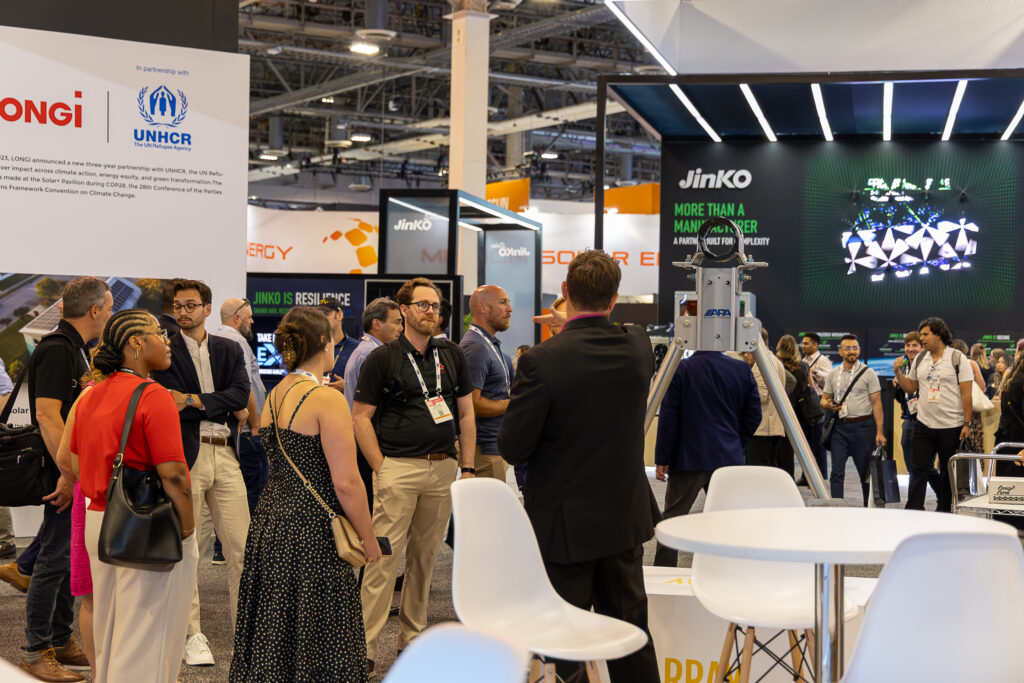 RE+ 2025, Day 2 of the trade show, September 10, 2025
Seamless Compatibility with our Foundation Solutions
The challenge: Selecting the right foundation is crucial to fostering a solar plant’s long-term reliability. Site owners, developers, and EPCs should carefully pair solar trackers with the right foundation to withstand harsh weather and challenging soil conditions.
The solution: With APA’s foundation expertise now part of ARRAY, we’ve simplified tracker-to-foundation integration, delivering a robust solution for solar projects, particularly in regions with difficult soils and terrain. APA specializes in advanced foundations and interfaces designed for solar trackers, engineered to excel in rocky soil, frost-heave areas, and other tough environments. ARRAY, a global leader in solar tracker technology, is known for its durability, reliability, and efficiency in maximizing energy production. As one company, we provide a seamless, high-performance solution for solar projects in even the most demanding conditions.
Why it matters: At RE+ 2025, customers were eager to hear about the combined expertise of ARRAY and APA. We’re presenting solar project developers and EPCs with a premier tracker + foundation solution to meet any challenging conditions, including rocky, frost-prone, undulating, and tough terrains.
Weather Resilience Is No Longer Optional
The challenge: Hail and wind are no longer “edge cases”—they’ve become central to procurement, insurance, and bankability decisions. Developers, insurers, and long-term asset owners are all demanding systems that can withstand increasingly volatile weather.
The solution: ARRAY’s resilience portfolio—including Hail XP, ARRAY SmarTrack® Hail Alert Response, and ARRAY’s patented passive wind stow—delivers automated stow, advanced monitoring, and field-validated performance while reducing production loss caused by high wind events. High-angle trackers combined with thicker module glass can reduce risk exposure by as much as 90% in high-hail regions, while our focus on “confidence of stow*” helps ensure systems respond reliably when it matters most. Furthermore, ARRAY, since inception, has designed our trackers to withstand high wind loads at full tilt. Site owners can stow with confidence for both hail and wind without increasing the number of piles or the strength of the foundations. Hail XP, SmarTrack Hail Alert Response, and passive wind stow provide site owners with a robust portfolio to handle the worst scenarios that Mother Nature can present.
Why it matters: Weather risk was one of the most discussed topics across panels and customer meetings during the show. On “The Impact of Extreme Weather Events on PV Design” panel, Evan Nichols, ARRAY’s director of technical sales, emphasized that resilience is now a baseline requirement—not an add-on. Paul Brown, managing partner with The Baldwin Group, reinforced that premiums are a math equation: lower risk = lower cost. And the industry-wide call for more granular field data underscored a clear trend—projects that can prove resilience through validated performance and real-world data will have a strategic edge in securing financing and lowering insurance costs.
*Note: “Confidence of stow” refers to the probability that a tracker system will successfully move to and maintain its protective position during a weather event. Higher confidence = greater assurance the system will respond as intended when it matters most.
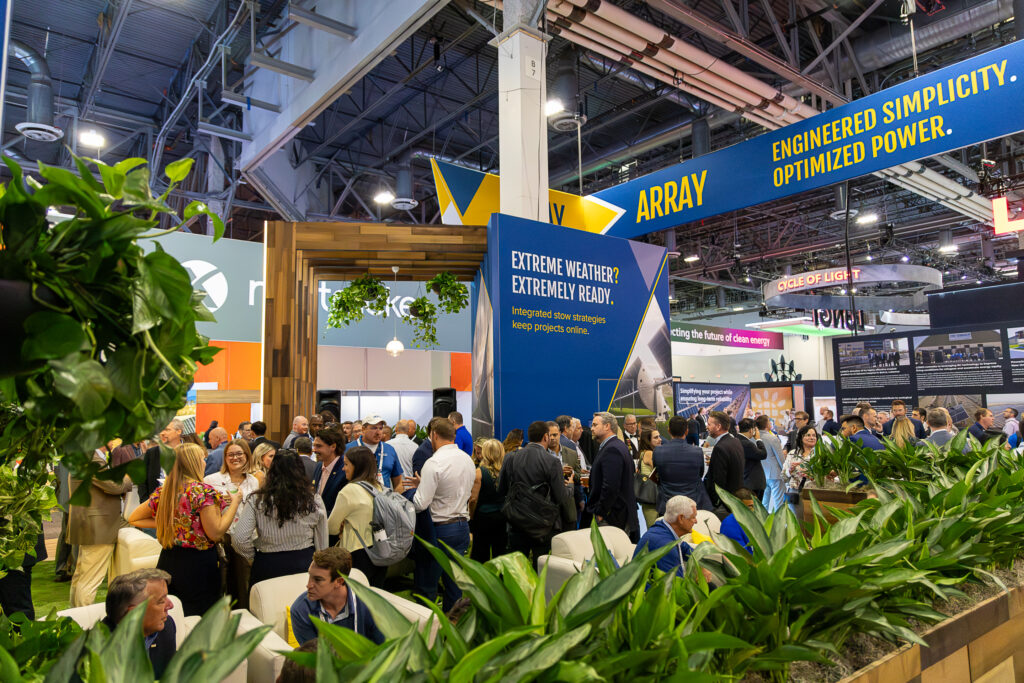
RE+ 2025, Day 1 of the trade show, September 10, 2025
Domestic Content Is Now a Decisive Factor in American Solar Project Success
The challenge: Developers are under increasing pressure to prove domestic content—not only to qualify for IRA incentives, but also to secure community acceptance and reduce exposure to global supply chain volatility.
The solution: ARRAY can now offer trackers that deliver 100% of the domestic content Assigned Cost Percentage (ACP) under the U.S. Treasury Department’s latest guidance (Notice 2025-08, issued January 2025). This capability is backed by a validated third-party “should” level opinion and certifications from our supply chain partners to help mitigate procurement risk.
Why it matters: The message from developers has been clear: domestic content is a decisive factor in enabling customers to maximize their tax credits. The Emerald Green Solar project in Indiana, developed by ENGIE North America, is already providing a real-world case of how ARRAY’s fully domestic trackers can support both project economics and community benefits.
Looking Ahead
Overall, what stood out to me the most was how unified the conversation has become around a few core priorities:
- reducing risk,
- integrated solutions under the panel, and
- ensuring projects perform for the long haul
Whether the topic was weather resilience, domestic content or integrated solutions, the common thread was clear—EPCs count on ease of install and owners want confidence that their investments will stand up to real-world pressures and keep delivering value.
As I look ahead, the way I see it, ARRAY’s role will be to continue supporting our customers, anticipating challenges, validating performance, and designing solutions that make projects more resilient.
The post RE+ 2025 Insights: What Developers and Owners Want from Utility-Scale Solar appeared first on ARRAY Technologies.
]]>The post ARRAY in the News: Agrivoltaics, Strategic Acquisitions and Policy-driven momentum appeared first on ARRAY Technologies.
]]>Join us in celebrating the progress, collaboration, and innovation.

Lime Kiln Agrivoltaics and pollinator support project goes live with ARRAY trackers
Recently, pv magazine USA covered the launch of the Lime Kiln agrivoltaics community solar project in Fulton, Maryland. The 2.7 MW site—now powering approximately 500 homes and businesses—demonstrates what’s possible when innovation meets intention. The project integrates sheep grazing and pollinator-friendly ground cover with ARRAY trackers, giving developers a flexible layout that accommodates diverse land-use goals.

ARRAY DuraTrack Hail XP praised for addressing extreme weather risks
“The new design comes at a great time,” said The Cool Down about our new ARRAY DuraTrack Hail XP system. Designed to protect solar panels in hail- and wind- prone regions, this tracker allows for modules to stow at a steep 77° angle—offering enhanced defense against extreme weather. The system’s ability to quickly reposition in response to hail events helps reduce the risk of damage and safeguard long-term project performance. This recognition underscores ARRAY’s focus on designing durable solutions that help EPC’s and developers protect their assets and stay on schedule.

ARRAY strengthens foundation and fixed tilt capabilities with APA Solar acquisition
List.Solar covered ARRAY’s acquisition of APA Solar fixed tilt mounting systems, for $179 million. This strategic move not only allows us to expand our product portfolio, but with APA’s expertise we’re better equipped to support a wider range of site conditions and project requirements and project requirement from single-axis trackers to fixed-tilt systems. This will help strengthen our ability to deliver integrated, field-proven solutions that meet the needs of today’s solar landscape for our customers.

Steel-framed modules take center stage in Origami + Array Webinar
A PV-Tech article by Eric Hafter, founder of Origami Solar, summarized a webinar discussion on the potential benefits of steel-framed modules in combination with trackers. Origami invited ARRAY to participate as an expert in the industry. During the webinar we shared how steel frames may help improve wind ratings, streamline tracker mounts, and offer design flexibility in certain environments.
At ARRAY, we’re focused on delivering reliable technology and customer support that help utility-scale solar projects succeed. We appreciate the recognition from respected industry voices and remain committed to providing solutions that meet the needs of the utility-scale solar industry worldwide.
If you want to stay up to date on all things ARRAY, be sure to check out our press releases and blog and find us on LinkedIn, Instagram and Youtube.
The post ARRAY in the News: Agrivoltaics, Strategic Acquisitions and Policy-driven momentum appeared first on ARRAY Technologies.
]]>The post Turning Weather Risk into Resilience: Insights from ARRAY and VDE Americas appeared first on ARRAY Technologies.
]]>Recent hailstorms—once considered rare—have already caused millions of dollars in damage across utility-scale sites. In a recent joint webinar, ARRAY and VDE Americas shared hard-won lessons and real-world data showing how smart stow protocols and real-time weather response can dramatically reduce site losses during extreme hail events.
If minimizing claims, reducing downtime, reducing insurance costs, and protecting long-term levelized cost of energy (LCOE) are priorities for your next project, check out the following to gain a better understanding of key points that could help you to turn weather risk into a manageable, strategic advantage.
The Growing Threat of Extreme Weather
Storms like the 2024 Fort Bend County hailstorms in Texas—events that shattered panels across utility-scale solar fields—aren’t outliers anymore. They’re the new reality, and a clear reminder that weather resilience strategies should be built into projects from day one.
Innovations that Strengthen Solar Resilience
ARRAY’s technology portfolio is designed with extreme weather conditions in mind, offering solutions that balance energy generation with asset protection:
- Passive Wind Stow Technology: Mechanically allows tracker rows to move to a safe position when wind-activated without relying on sensors or electronics, helping preserve system reliability during high wind events.
- ARRAY SmarTrack® Hail Alert Response: Uses advanced weather APIs to send real-time alerts and trigger automated stow commands tailored to specific site conditions. Proactively positions trackers before and during severe weather events to reduce damage risk. Provides a built-in end-to-end functionality and communications verification platform to minimize complex counterparty risks.
- ARRAY SmarTrack® Automated Snow Response: Uses ultrasonic snow depth sensors to identify snow accumulation and intelligently adjust trackers to maximum tilt angle.
Field Insights: Fort Bend County Case Study
Real-world data provides the clearest Illustration: resilience strategies can dramatically impact outcomes. In the aftermath of the two major hailstorms hitting Fort Bend County within 12 hours, VDE Americas conducted a forensic analysis across affected solar sites.
Key findings included:
- These large sites had more severe module hail risk exposures: 2mm glass-glass construction, a maximum tilt angle of 52 degrees, and large hail strikes.
- Sites using ARRAY’s defensive hail stow protocols experienced demonstrably less module damage.
- Reliable tracker stow activation made a measurable difference in minimizing asset loss.
- Nighttime stow procedures were critical, as both hailstorms occurred outside normal operating hours with the largest hailstorm occurring in the middle of the night.
Top Priorities for Effective Hail Stow:
- Tracker Stow Activation: Ensuring that the tracker system moves to its designated stow position quickly is paramount. ARRAY’s DuraTrack® with Hail Alert Response has demonstrated consistent success in all rows on the site, achieving maximum stow angles for effective protection.
- Stow Direction Relative to Wind: Trackers should be stowed away from the incoming wind to minimize the impact of hail. ARRAY’s Hail Alert Response System allows customizable stow directions, enhancing resilience against hail and wind damage.
- High Stow Angle: Stowing at steeper angles, like the 52-degree angle used by DuraTrack®, has proven to effectively withstand hail impacts of 75mm or larger. This provides better protection for solar modules. ARRAY has also announced a new 77-degree stow angle product for extreme weather sites with larger hail exposures.
ARRAY’s Solution to the Wind and Hail Stow Angle Dilemma
One of the biggest challenges for site operators is balancing hail and wind protection—often forced to choose one at the expense of the other. A high angle tilt is often optimal for hail while a low angle tilt is usually preferred for wind. ARRAY’s hybrid active-passive stow technology solves this stow dilemma:
- Passive Stow Efficiency: Passive stow is wind activated and only impacts rows experiencing high winds. High wind forces will cause effected rows to quickly slip to the nearest maximum tilt angle, minimally affecting hail risk.
- Minimizing Energy Loss: The mechanics of passive stow cause only the rows experiencing high winds to stow, while unaffected rows continue normal operation—maximizing full energy yield capture on all other unstowed rows without compromising tracker safety.
This engineered approach delivers greater site resilience without materially sacrificing operational efficiency or project yield compared to other tracker products.
Future-Proofing Solar Investments
The future of utility-scale solar depends on proactive weather risk management. Innovations like ARRAY’s high-angle stow solutions and advanced modeling tools are already reshaping site design strategies:
- High-Angle Trackers: Provide critical protection during increasingly severe hailstorms.
- Yield Modeling Advancements: New energy loss models show passive stow systems can significantly lower yield loss compared to conventional active-only stow solutions, improving long-term project returns.
Actionable Takeaways for Stakeholders
If you’re planning your next utility-scale project—or evaluating risk strategies for an existing portfolio— here are some critical action steps that you should take into consideration:
- Implement hail stow protocols customized to your site’’s risk profile.
- Leverage real-time forecasting and automated stow solutions like the ARRAY SmarTrack® Hail Alert Response.
- Choose field-proven, engineering-driven technologies like ARRAY’s DuraTrack® to balance performance and protection.
Industry Outlook: Turning Risk into Resilience
As the industry adapts to a new era of climate volatility, proven resilience strategies are becoming a non-negotiable part of solar success. With innovations built for real-world challenges, ARRAY and VDE Americas are helping project owners protect investments—and power the future with confidence.
Learn more about ARRAY’s SmarTrack® Hail Alert Response or explore additional insights from VDE Americas.
The post Turning Weather Risk into Resilience: Insights from ARRAY and VDE Americas appeared first on ARRAY Technologies.
]]>The post Solar Farms Get Smarter: ARRAY’s Innovative Approach to Weather Resilience and Boosting Energy Production appeared first on ARRAY Technologies.
]]>What Solutions Does ARRAY Offer Solar Farms?
With patented passive wind-stow technology and the ARRAY SmarTrack range of software and control-based products, including ARRAY SmarTrack Hail Alert Response, ARRAY provides comprehensive solutions designed to:
- Maximize energy production using real-time data and advanced algorithms.
- Protect solar panels from extreme weather conditions, including wind and hail.
- Minimize operational costs through zero scheduled maintenance requirements.
These innovations not only enhance energy output but also bolster the long-term durability and resilience of solar installations, helping solar farm operators safeguard their investments while maximizing profitability.
Advanced Solutions for Solar Farm Efficiency and Durability
ARRAY trackers are equipped with state-of-the-art passive wind mitigation mechanisms, making them well-suited for diverse and challenging climates like those found in Australia. Even at maximum tilt, ARRAY tracker systems are engineered to withstand wind speeds of up to 225 km/h (140 mph), whether facing into or away from the direction of the wind. In some cases, they can handle even higher speeds, depending on specific project conditions.
The patented passive wind-stow system automatically adjusts tracker angles based on real-time wind conditions, delivering reliable performance and safety across a range of environments—from the intense heat of the Outback to the strong coastal winds of North Queensland. When wind speeds trigger the system to move to its maximum tilt, it adopts the safest position to endure high winds from any direction while also minimizing potential hail damage. This reduces the risk of system downtime and costly repairs, providing continuous protection and performance.
Similarly, ARRAY’s Hail Alert Response system provides fast, effective protection against hail threats, helping to safeguard solar panels from potential damage.
How ARRAY’s Hail Alert Response Works:
- Real-Time Storm Data: The system gathers local storm data from a trusted weather service, including forecasted position, hail probability, and storm trajectory.
- Site-Specific Alerts: If severe hail is likely, SmarTrack generates a targeted alert and communicates it via the SmarTrack Data Platform.
- Automated Response: The SmarTrack Controller adjusts the trackers to the best defensive position—either at maximum tilt away from the storm’s direction or the closest possible maximum tilt.
These measures help keep solar farms operational and protected, even in harsh weather conditions.
Beyond weather protection, ARRAY’s SmarTrack software suite includes solutions like ARRAY SmarTrack Backtracking and ARRAY SmarTrack Diffuse, which play crucial roles in maximizing energy yield. Backtracking adjusts tracker angles to reduce shading caused by terrain variations, while Diffuse optimizes panel angles during cloudy or low-light conditions. These adaptive tools enable solar farms to increase energy production even in challenging environments, leading to higher returns on investment and improved profitability for solar farm operators.
ARRAY recently announced the development of a 77-degree stow capability for its tracker systems, the steepest stow angle for hail protection in the industry. This innovation provides enhanced flexibility and protection from both hail and wind, reinforcing ARRAY’s position as a leader in extreme weather solutions for the solar industry. The 77° stow is designed to achieve superior protection by reaching a high-tilt angle in either direction, regardless of wind speed or direction. Additionally, this angle offers all the benefits of passive wind stow, including up to 5% energy gain compared to active stow trackers.
ARRAY’s trackers also require zero scheduled maintenance, further reducing operating costs for solar developers. These features make ARRAY’s technology an indispensable tool for EPCs, developers, and investors aiming to maximize project profitability.
Proven Solutions in Major Australian Projects
ARRAY’s tracking solutions have demonstrated their effectiveness in large-scale projects across Australia and New Zealand, including the upcoming deployment of a nearly 320 MW ARRAY OmniTrack terrain-following tracking system and a 130 MW ARRAY DuraTrack® system in the Victoria Goorambat and Horsham regions. These projects help support the local economy by using Australian-produced steel.
Collaborations with leading developers such as Neoen, Engie, and OX2 highlight the value of ARRAY’s technology in large-scale solar installations, where efficiency, durability, and weather resilience are critical to success.
As Australia continues to embrace solar energy, ARRAY remains a trusted partner for developers and investors. With its advanced solar tracking technology, proven track record, and local expertise, ARRAY is helping shape the future of renewable energy in Australia.
For more information on how ARRAY can support your next solar project, contact Aaron Zadeh or Michael Corio.
The post Solar Farms Get Smarter: ARRAY’s Innovative Approach to Weather Resilience and Boosting Energy Production appeared first on ARRAY Technologies.
]]>The post Innovations and Insights: ARRAY at PVPMC 2024 appeared first on ARRAY Technologies.
]]>This year, ARRAY was honored to share our knowledge and leadership in modeling solar tracker impact on energy production, highlighted by a key presentation from one of our Senior Engineering Managers, Kendra Conrad, on the “Energy Impact of Different Solar Tracker Wind Stow Strategies.”
Kendra’s talk on wind-stow energy loss drew a crowd and kicked off some great discussions. She introduced ARRAY’s proprietary modeling methodology and showed how ARRAY DuraTrack® trackers’ mechanical passive wind stow solution yields minimal energy losses—peaking at just 0.14% across 12 diverse locations. In contrast, sensor-based active stow strategies exhibited significantly higher losses, with a maximum of 4.2% for the same sites.
The enthusiastic feedback and questions that followed underscored the importance of this innovative work. Kendra’s insights not only illuminated the superior efficiency of our passive wind stow solution but also highlighted the substantial advantages it offers in optimizing energy retention.
So, to continue the momentum, here are two questions we tackled and three major insights we took away from PVPMC 2024.

ARRAY Senior Engineering Manager, Kendra Conrad, presenting at PVPMC 2024.
2 Burning Questions from PVPMC 2024
1. Is ARRAY’s Mechanical Passive Stow a New Feature?
At PVPMC 2024, we fielded a lot of questions about the advantages of our DuraTrack tracker, especially about its passive mechanically activated stow feature. Kendra explained how ARRAY’s technology has evolved continuously to meet the high demands of today’s solar infrastructures, ensuring top-notch performance and longevity. Our patented, safe, passive wind stow technology is a fundamental component of the latest DuraTrack version and future iterations.
What sets ARRAY’s wind stow technology apart?
Unlike traditional sensor-based active stow methods, which rely on the control system functioning during adverse weather and can cause significant energy loss, our technology offers a more reliable solution. It is designed to protect your equipment from wind damage without sacrificing energy output. This innovation is a true game changer for our customers, aiming to enhance both equipment reliability and energy yield.
2. How Do Individual Rows Stow in the Linked Architecture?
A focal point of Kendra’s talk was the innovative mechanics behind ARRAY’s linked architecture, which is crucial for reliable solar tracker operation in adverse conditions. So, what exactly is a linked architecture, and how can individual rows still stow during high wind events?
Our linked architecture enables multiple rows of solar panel trackers to rotate together as a single unit. This design can be especially cost-efficient and reliable for large utility-scale solar installations. By orienting a large number of solar panels with just a few motors and controllers, our architecture strives to maximize efficiency and minimize costs.
Having a strategy to deal with high wind events is critical to solar tracker design. Our DuraTrack trackers feature a torque-limiting clutch on every row, which mechanically activates during high winds. The clutch automatically stows the rows where the mechanical thresholds have been exceeded to the nearest maximum tilt.
In this optimal position, mechanical stops on every pile transfer the wind load directly to the ground, ensuring maximum protection. Stowed rows act as wind barriers for the rows behind them, allowing the unstowed rows to continue tracking normally even during high winds. This can drastically reduce downtime and energy loss, as only a small fraction of the rows need to stow.
Additionally, this stow position is ideal for hail protection, linking seamlessly with our ARRAY SmarTrack Hail Alert Response to offer superior defense against hail damage.
3 Key Takeaways from PVPMC 2024
1. Acknowledgment of ARRAY’s Collaboration with Labs and Universities
Our commitment to advancing solar tracker technology by collaborating with labs and universities garnered positive mentions multiple times during the conference.
A few mentions that stood out were:
- Jim Crimmins of CFV Labs proposed using ARRAY DuraTrack trackers in their outdoor yard to build physical twins of utility installations. These reference arrays will aid in degradation monitoring. CFV Labs, an ISO-accredited solar test laboratory in New Mexico, has worked with us for over a decade. In 2019, we built a DuraTrack installation to study tracker design’s impact on bifacial systems.
- Dr. Ana Dyreson of Michigan Technological University shared results on the different snow-shedding strategies they have tested using ARRAY DuraTrack trackers at the Michigan Solar RTC. The Michigan Solar RTC is part of the DOE-funded Regional Testing Center program. ARRAY had built a DuraTrack installation at the Michigan RTC back in 2022 to demonstrate the reliability of our trackers in high-snow areas.
These mentions reflect the collaborative relationships that we have built over years, working together with industrial and academic partners to advance the solar tracker technology.
2. Heightened Interest in Hail Mitigation Strategies
The robust dialogues around hail mitigation strategies underscored the industry’s urgency in addressing weather-related challenges, with ARRAY at the forefront of developing risk-mitigation technologies. Even talks that did not mention hail—including Kendra’s—received questions related to hail. Many conversations focused on the massive damage that a solar farm in Texas suffered in March earlier this year.
So, what’s ARRAY’s strategy for handling the unpredictability of hailstorms?
ARRAY offers two primary solutions to help mitigate the risk of hail at your site:
- Manual Hail Stow Solution: This allows site operators to stow all DuraTrack trackers to a safe position (maximum tilt) with a single click on the user interface or with a manual switch on-site.
- ARRAY SmarTrack Hail Alert Response System: This system automatically triggers the safe-stowing action when hail is forecasted for a site, removing potential human factors from the hail mitigation plan.
These solutions ensure your site is protected against hail damage, enhancing the resilience and longevity of your solar installations.
3. Growing Concern Over Equipment Availability
The conference discussions highlighted the critical importance of equipment availability in accurate energy modeling—a factor now recognized as essential for understanding and resolving underperformance of utility PV power plants. Participants discussed how to correctly incorporate equipment availability in the energy models to improve the accuracy of P50 and P90 values used for project development and financing.
At ARRAY, we set ourselves apart in tracker availability through innovative features that enhance uptime and energy production. The simplicity of our DuraTrack linked architecture, which includes significantly fewer parts per MW than competitor tracker products, results in higher uptime. Plus, DuraTrack’s mechanical passive wind mitigation limits the frequency of stow events, which can result in higher uptime and minimize wind-stow energy losses.
PVPMC 2024 provided a dynamic platform for ARRAY to showcase our dedication to pushing the boundaries of solar tracker technology. We hope the industry adopts the modeling methodology Kendra presented to accurately include wind-stow energy losses in energy production estimates.
We invite industry professionals to engage with us further, share insights, and discuss future collaborations. For more information on our technology and services, or to schedule a detailed discussion, please visit our contact page.

The post Innovations and Insights: ARRAY at PVPMC 2024 appeared first on ARRAY Technologies.
]]>The post How Technology Is Protecting Solar Farms Against Extreme Weather [WEBINAR RECAP] appeared first on ARRAY Technologies.
]]>The dilemma is clear: solar panels are getting bigger, and the glass and wafers are getting thinner, increasing the risk of damage in the face of hail and other severe weather. This puts insurance companies at a crossroads—do they hike premiums to cover these growing risks, step back from insuring solar sites altogether, or is there another option?
In a recent webinar, Brandon Taylor, senior director of business development at ARRAY Technologies, discussed the current state of tracking technology and how trackers are helping protect solar farms against extreme weather. He was joined by industry experts John Sedgwick, president of VDE Americas, and Mike Perron, co-leader of Brown & Brown Risk Solutions’ Global Energy & Climate Tech practice, who shared their thoughts on keeping solar farms safe and making sure insurance can be fair and reasonable for everyone involved.
Watch the full webinar below or keep reading for some key takeaways from this insightful discussion!
Current State of Hail, Severe Weather, and Insurance
Mike kicked off the discussion, sharing one insurer’s observation that hail-related damage accounts for 55% of all insured losses on photovoltaic (PV) solar projects. Currently available data, however, suggest that stowing solar projects significantly reduces damage from hail. Though thinner module glass has been cited as a disadvantage in hail resiliency, proper stowing plays a greater role in preventing weather-related damage than glass thickness.
The National Oceanic and Atmospheric Administration classifies thunderstorms, or convective storms, as those with wind speeds at or above 58 mph or hail greater than 1 inch in diameter.
These severe storms are happening more frequently across the U.S. Brandon went on to share that insurance companies are becoming more interested in how to mitigate damage from these storms due to increasing number of multimillion-dollar insurance claims from hail damage. Many insurance companies now require risk management strategies before they will insure sites.
Without realistic risk mitigation strategies, insurance could be prohibitively expensive or offer minimal coverage. Insurance providers are aware that positioning solar panels at a steeper angle prior to a hail event can mitigate damage. So why does damage continue to occur?
Brandon shared two reasons losses are still happening, even if manufacturers and owners have risk mitigation strategies in place:
- Substandard structural designs that don’t withstand the weather challenges.
- The failure or inability to stow panels correctly and timely.
The above webinar delved into these challenges, presenting actionable solutions for insurance providers, site developers, and owners to navigate the evolving climate landscape.
Mitigating Risk Through Structural Design
Wind and hail often happen together. So, if a system is not designed for full-site wind speed at max tilt, site operators have a complex decision to make. Stow for hail, which increases their risk of wind damage, or stow for wind, which increases their hail damage risk?
The optimal solution is to design a tracker to withstand full-site wind speed at any angle in either direction—which is exactly what ARRAY has done. This approach significantly reduces the risk of damage from both wind and hail simultaneously. Unlike most of our competitors, ARRAY has embraced and implemented this robust design standard for over a decade.
Our trackers are also capable of stowing only the rows that are directly threatened by severe weather, allowing the rest to continue harnessing solar energy. The system conducts recalibration routines morning and evening, resetting any rows affected by the day’s weather disturbances.
Why is the safest tracker position during a severe storm fully tilted away from the wind? This orientation means hail is more likely to strike at an angle, lessening the chance of module damage. With our strategy, the risk of breaks or microcracks in panels diminishes because hail hits at an oblique angle instead of directly.
Stowing into the wind = system risks damage from hail as small as 2-2.5 inches in diameter.
Stowing away from the wind = can help protect systems from hail up to 3.5-4 inches in diameter.
ARRAY’s commitment to innovative design extends the durability of solar modules and mitigates the risks that concern insurers and site developers alike.
Mitigating Risk Through Automated Response
Brandon went on to share how the severe weather risk management feature incorporated into ARRAY’s SmarTrack platform reduces risk by eliminating the need for manual intervention and other steps that could lead to not stowing during a hail event.
When a severe weather alert is issued, SmarTrack automatically positions the solar panels into a secure stow mode 30 minutes before the storm is forecasted to strike. It’s not just about taking shelter; it’s about smart recovery too. The system emerges from its protective stance 30 minutes after the danger has passed, ensuring seamless operation and energy production.
This automation eliminates the need for 24/7 personnel to monitor sites and the extensive training required to manually execute stow commands during emergencies.
Risk management is not an afterthought at ARRAY—it’s embedded in every phase, including construction. ARRAY’s technology utilizes a passive stow strategy—rather than an active one—enhancing protection even when the site is under development and not yet fully operational.
VDE’s Research into the Risk of Severe Weather Damage
VDE has created tools for the industry to measure risk—like a hail durability test— and is actively developing additional testing methods. John then elaborated on how factors such as module technology, packaging, and construction are vital in assessing a solar site’s vulnerability to hail and wind.
Through their research, VDE found that tracker-defensive stow capabilities and response times play an important role in helping mitigate weather risk exposure. During the webinar, John shared a few more of his company’s findings, including:
- The maximum tilt angle is a defensive hail stow position; increasing tilt angle dramatically reduces the exposed area of the modules.
- Wind resilience is based on wind speed and direction.
- Response capabilities include the time required to execute hail stow.
Their recommendation is clear: transitioning to an automated hail response system is beneficial. This shift from a manual, multistep process to a streamlined, automated response enhances protection against severe weather.
VDE’s Comprehensive Risk Reports
VDE offers detailed reports that are indispensable for managing risk in the solar industry, including:
- Probable maximum loss reports: Used by insurance companies to ensure insurance terms and conditions. These reports provide risk based on local meteorological conditions and site specifics.
- Poisson risk exposure reports: These reports determine the risk outside insurance terms and conditions for owners and inventors.
VDE looks at hail risk over a 40-year time frame and estimates actual dollar amounts given the product and site specifics.
Strong winds before, during, and after an event may not correlate to storm direction. Wind increases the terminal velocity of hail falling naturally, which means you need to increase the defense to protect the modules.
The bottom line: Operating your system appropriately for the particular wind situation can reduce probable maximum loss and your financial exposure. Operating your system incorrectly can increase your exposure.
Here are some best practices for mitigating severe convective storm risks:
- Quantify the risk exposure on a site- and product-specific basis.
- Implement proven and quantifiable risk mitigation strategies—including with regard to the tracker, operation, and modules.
- Minimize inertia in the severe weather risk mitigation protocols and systems—the time from alert to mitigating stow is critical.
For more details on VDE’s research and ARRAY’s tracker response to help mitigate severe weather risks and to see the Q&A, check out the full webinar.
SIGN UP TO BE NOTIFIED FOR UPCOMING WEBINARS
The post How Technology Is Protecting Solar Farms Against Extreme Weather [WEBINAR RECAP] appeared first on ARRAY Technologies.
]]>The post How Robotics Can Help Global Renewable Energy Goals & Create Jobs appeared first on ARRAY Technologies.
]]>According to estimates, the solar sector will need to reach 400,000 jobs by 2030 and more than double by 2035 to meet climate goals set last year.
How can solar project developers meet higher demands while keeping projects on track? And how can the solar industry train thousands of skilled workers and get them up-to-speed and ready to work?
One answer is robotics. The role of robotics is more important than ever amid the workforce limitations in the solar industry. New technology will play a critical role in developing utility-scale solar projects to help meet energy goals in the U.S.
Deploying robotics technology enables the industry to achieve ambitious solar deployment goals because it makes solar construction more efficient while shortening operator training times. From shipping and packing methods and transportation to installation, robotics provides a way to shrink the labor and time needed to deploy utility-scale solar.
Solar & Robotics Technology and Process
Many companies are already looking to crack the robotics code in utility-scale solar. One company, Sarcos Technology and Robotics Corporation (Sarcos), uses technology that provides intelligent mobile manipulation systems for complex and often dangerous outdoor environments, making the role of robotic applications helpful in improving safety, productivity, and efficiency.
Sarcos’ robotics have been applied in the aviation, defense, energy, and medical industries. The company uses robotic arms, human-directed controllers, robotic systems, and advanced autonomy software (artificial intelligence) “to develop robotic systems that empower humans to do their jobs safely and efficiently.”
Applying Robotics Expertise to the Solar Industry
The use of ‘supervised autonomy’ provides safer roles for human operators by delegating dangerous tasks to the robot. When riskier jobs are assumed by human-controlled mechanical arms in applications like solar construction, it can shorten project timelines while reducing accidents and injuries.
Solar modules are large pieces of fragile equipment that require significant manual labor hours to deliver and install. With solar modules trending upward in size, they’ll only get heavier and trickier to handle.
Large solar sites are generally in remote areas like deserts or mountainsides. These locations are great for solar projects but can be demanding on manual laborers, especially in harsh environmental conditions. Adding robotics to the solar construction industry can make project installation safer and quicker.
Using a $1.9 million grant from the Department of Energy’s Solar Energy Technologies Office (SETO), ARRAY Technologies and Sarcos have collaborated to implement robotics into solar projects across the country. The program aims to develop a robotic system for the Outdoor Autonomous Manipulation of Photovoltaic Panels (O-AMPP). In addition to ARRAY and Sarcos, the collaboration includes JLG Industries, Mortenson, and Pratt Miller.
Sarcos will use computer vision and machine learning with its autonomous robotic technology to deliver, manipulate, and install solar modules in challenging locations. By buffering the dangerous aspects of solar module maneuvering and installation, these smart robotic arms are creating processes to move solar equipment faster and build sites with fewer errors.
ARRAY will supply the tracker technology, and our engineers will collaborate with teams from contributing companies. By helping the development of this technology, ARRAY has the potential to play a vital role in changing the face of the solar industry through entirely new workflows and implementations.
How Robotics Can Help the U.S. Achieve Carbon-free Energy Goals
The increase in efficiency and safety associated with robotics has the potential to enable solar project developers to ramp up production to the levels we need to hit to achieve the DOE’s 2035 and 2050 energy goals. These goals call for 95% decarbonization by 2035 and 100% decarbonization by 2050.
Solar would need to account for 45% of electricity generation to achieve these levels by 2050. The Solar Energy Industry Association estimates that solar installations must increase by 60% above current forecasts between 2022 and 2030 to meet these climate targets.
According to the 2020 National Solar Jobs Census by the SEIA, The Solar Foundation, the Interstate Renewable Energy Council (IREC), and BW Research, the industry is facing significant workforce limitations.
This widespread industry labor shortage was brought on partly by workforce training and mobilization lags caused mainly by the pandemic. Just as training for skilled workers in solar began to ramp up, most of the world was put on hold.
Despite these challenges, demand for solar energy has only increased. This is a good thing, but logistically there are not enough people trained and ready to meet the demand. Robotics opens opportunities for people to learn skills around supervising these operations.
Robotics’ Role in Ramping Up Solar Despite a Labor Shortage
Given the limitations of a tight labor market and a labor-intensive installation process, robotic automation is expected to be a critical force multiplier in the global effort to increase the development of solar energy projects. Developing and refining robotic construction capabilities is essential for boosting solar deployment that’s also safer for humans. It creates new jobs for skilled laborers, with shorter training timeframes and fewer risks when they start work.
We see collaboration with robotics leaders as one of many essential steps in helping the utility-scale solar industry think in broader terms and realize new productivity levels. All this can make U.S. energy and climate goals a reality—a win for the industry, the U.S. climate, and the world.
The post How Robotics Can Help Global Renewable Energy Goals & Create Jobs appeared first on ARRAY Technologies.
]]>The post America’s Solar Energy Agenda for 2050: Our Wish List to Make It Reality appeared first on ARRAY Technologies.
]]>The Biden administration recently announced a goal to produce 45% of US power from solar sources by 2050. To give some perspective, currently, solar power is under 4% of the US power grid but has accelerated at record rates over the past decade.
A blueprint to ramp up and meet these ambitious goals was outlined by the Department of Energy (DOE), projecting that solar power installation would have to be doubled over the next four years, then doubled again by 2030. Put another way, that means installing 30 gigawatts per year of solar capacity between now and 2025, and another 60 GW a year between 2025 and 2030.
That may seem daunting, but the utility-scale solar industry continues to grow at a breakneck pace. In order to reach these ambitious goals, we need to do something much differently than what got us to this point.
Ambitious Energy Goals – Can It Be Done?
After absorbing the DOE Solar Futures study, we do think that solar could ultimately make up 45% of total power generation in the US by 2050. With one massive caveat—you can’t get there without utility-scale solar. This conclusion is also supported throughout the DOE’s report. In other words, rooftop solar alone will not be enough.
This isn’t meant to dimmish the importance of rooftop solar—we support all the many ways solar can power the world with clean energy. But in order to make the massive shift to clean energy and move to a more carbon-neutral scenario, utility-scale solar deployments will be a necessity. And the price of solar has dropped 70% over the last 10 years, making it an ever-attractive and efficient way to deploy clean energy. A government-backed solar proclamation isn’t enough to make it a reality.
There will be lots of challenges, and it will require Herculean efforts like federal investment and major policy change. Unfortunately, money and policy will not be enough. Increasing utility-scale solar capacity will require incredible coordination with utilities, private and public investors, regulators, and more.
Even with all of these challenges, the possibilities of inexpensive, clean energy and ultimately a chance to substantially reduce carbon emissions by 2050 is real—and a future we are excited about. As we look at what is possible for utility-scale solar, there are essential actions that must be taken to clear the way for the short and long-term challenges that lie ahead.
The Biden’s administration’s announcement was a headline we were excited to read, but one that must be coupled with complementary action to drive change. Here are our six wishes to make the 2050 solar goals a reality:
- Creation of a stable regulatory and incentive environment so that the industry can make long term commitments to funding and capital
- Enhancement to the aging power grid so that there are fewer disruptions and consistent power delivered to homes and businesses across the US
- Streamlined permitting for solar so new sites can be identified and deployed faster
- Investment in battery storage technologies which will help to smooth the output of power
- Develop productive trading relationships with international module manufacturers so there is diversity in the supply chain
- Deployment of tax credits. Reuters reported 700+ companies requested long-term extensions of a solar investment tax credit in recent letters to Congress — this extension would “ease project financing challenges” and make the feat ahead of us more feasible.
The Solar Vision for 2050 is an American Story
At ARRAY, we take pride in knowing that the growth of solar means an increase in American jobs. The growth of a clean energy economy will create tens of thousands of jobs for Americans. In 2020 alone, more than 230,000 Americans worked in solar at more than 10,000 companies in every U.S. state. In 2020, the solar industry generated more than $25 billion of private investment in the American economy.
Solar is growing and continuing to put up the big numbers! And ARRAY is a U.S.-based company with U.S. manufacturing capabilities and a significant U.S. supply base. We are excited for the possibilities of how the clean energy economy will change the face of the nation’s carbon footprint and how it will transform the opportunities for American workers.
With a 30-plus year history of developing the world’s most innovative solar hardware and software, we’ve learned that solar is not tied to the outcome of an election or the passage of any one piece of legislation. Solar technology is no longer a fledgling experiment. It has developed into a sector that is beating out other modes of electricity generation and is getting better every day.
Today, we know that the speed to bring power generation online is faster with solar, when compared with wind, natural gas and nuclear. And when considering the consistency in energy delivery and steadiness of output, utility-scale solar comes out on top too.
The Ending Is Just the Beginning
We need an end to the idea that solar is a fad or some partisan point of debate. Utility-scale solar is an economic driver, a carbon neutralizer, a job creator and an electric power producer like no other. Solar provides a way to significantly impact climate change in a way that is financially beneficial to utilities, economically viable and safe for users and environmentally friendly for the planet.
While there are many challenges that lie ahead for the adoption and execution of solar’s future, we remain hopeful. If you are looking for us, we will be over here following the sun…and getting excited about turning vision into reality.
Check out more of our take on the Biden 2050 solar energy plan in this clip from Cheddar News
The post America’s Solar Energy Agenda for 2050: Our Wish List to Make It Reality appeared first on ARRAY Technologies.
]]>The post Real-World PV Tech Development at the ARRAY Tech Research Center appeared first on ARRAY Technologies.
]]>Much of large-scale solar technology development happens behind closed doors. Engineers in laboratory settings, tucked away from sight, calculating and generating the next big solutions.
You may have seen the news about us launching our ARRAY Tech Research Center. In this post, we’ll share more details about exactly why this center is so groundbreaking and exciting.
The research center is a testing ground for engineers, developers, and EPCs to get hands-on experience exploring different challenges encountered on the ground at a site-by-site level.
The importance of this ground-level experimentation goes hand in hand with ARRAY’s perspective on covering all aspects of research. We’re believers in both modeling and testing in the real world. Rob Rowan, senior vice president of engineering operations at ARRAY, put it this way:
“It’s the difference between developing in a vacuum or modeling first and then testing in the real world. We’re not building and breaking until it works, [instead, we’re] modeling first to catch any obvious flaws and then testing in the lab and in real-world settings.”
The tech research center allows for this testing in a collaborative way. It allows time and a dedicated space to hear about customer challenges for individual sites and situations. This is important because it’s easy to think that we’ve thought of everything when we make an incremental change to a tracker or to a specific component on the tracker, but until you get that real-world voice from the customer, you don’t know for sure.
There are two sets of people who really benefit from the center. One group is developers and forward-thinking EPCs interested in things like future-generation trackers, looking at the interface with larger modules, etc. The other group is strictly EPCs who are interested in the constructability and the mechanics of essentially building a tracker.
Both of these groups tell us how much of a difference it makes to physically try out equipment and processes versus a proposal that is written in PowerPoint decks. It essentially brings theory to life and makes planning more tangible.
A Testing Ground for Specific Conditions
ARRAY’s vice president of strategic product marketing, Jon Sharp, used module size as an example of a problem we can troubleshoot at the center.
“One of the things we do at the research center is build our existing trackers and our future generation trackers, and we can then disassemble and rebuild, and come up with the most efficient way to install certain components.
“In the case of large modules, we can try assembling with different numbers of people on the crew, try assembling with the module on the ground, or on equipment, or something along those lines, and [then we can] figure out what we think is the fastest, safest, and most efficient way to install these different components,” Sharp said.
Using the center in this way makes tailoring solutions to specific people and their unique problems more precise.
Collaborative Problem-Solving in Partnership with Customers
Collaboration is a key aspect of the research center. Different approaches to procedures can be tested and compared, and pros and cons can be evaluated between engineers and customers to explore construction efficiencies.
Another example of how we’ve been collaborating recently is our work with EPCs who are either brand new or have construction experience but just haven’t built out solar before. This is happening a lot at the moment because there’s a capacity/supply shortage of EPCs in the industry right now.
There’s no substitute for getting out there and having EPCs put their hands on our tracker and see them actually built.
We can see the light bulbs going off in their heads as they visualize how they can build these sites. They’re taking notes; they’re thinking about how they’re going to stage the different material on the sites. We’re not only hearing the voices of existing customers, but we’re also working with new customers, especially as new EPCs enter the marketplace. We’ll only see more of that over the next two years.
Jon Sharp hit on the possibility for the center to work as a training ground for installers: “With no time pressures [and] no production schedule, the center is a space where engineers can relay information on how things are intended to fit together and where installers can try it out in real-time.”
Rob Rowan said he sees the center standing out as a hub of innovation for future-gen PV tech as a whole. This is happening through extending our collaborative efforts not only to customers, but also to suppliers and partners.
He also summed up the importance of collaboration nicely when he talked about how the ability and willingness to collaborate over the next five years and beyond will separate the true innovators in the utility PV industry from those who are willing to carry on with the status quo.
Intersection of the ARRAY Tech Research Center and the Future of Utility PV Tech
When asked, Jon Sharp talked about the short-term outcomes of the research happening at the center. He noted how, considering that utility-scale solar development cycles can run anywhere from six months to three years, projects that are only just now being conceptualized by developers will benefit when it’s time to break ground. They’ll benefit from the exact actions we’re taking today at the research center.
“They’re planning their price points three years from now to be lower; they’re planning for their installation efficiencies to be better. And they’re banking on people [working in companies] like ARRAY coming to the forefront with better ways to do things by the time those lines intersect a couple of years out,” said Sharp.
Since one objective of the research center is to showcase new technology, the tech in the center will constantly evolve. It will become a rotating site for the freshest ideas and their real-world applications.
“We’re also prioritizing looking at things on a component level in addition to an overall new product level. Incremental changes in tracker advancements, as well as improvements on components, are all important.
“Those incremental updates are really crucial. They’re key for our customers from an efficiency standpoint, and for us from a cost standpoint. The overall market is driving decreases in costs. One way to do that is to make our existing tracker and our existing components less costly by refining them,” Sharp continued.
Making Connections That You Just Can’t on Zoom
This quote below from Jon Sharp gives a clear picture of what we’re doing at the research center and why we’re so thrilled about it:
“This research center is in close proximity to our engineers, [and] it really just affords them an opportunity to go try things, [and perhaps try again] and fail, and [it] really gives them a laboratory to improve our technologies going forward.
“And that’s really important. It’s one thing to do it in a lab and on a computer, but it’s a lot different when you put a hard hat, a set of safety goggles, and safety shoes on, and you go out and you have to install things. It really allows our engineers a great place to be creative.
“Our customer base is excited about it; it’s a great place to talk about ideas, and there’s nothing like looking at the actual hardware to bounce ideas around, because your brain will see things in the real world that it won’t see on a Zoom meeting or something else. It really puts some reality around the creative process for our customers and ourselves.”
The post Real-World PV Tech Development at the ARRAY Tech Research Center appeared first on ARRAY Technologies.
]]>The post Utility-Scale PV Solar Trends: Increasing Power and Module Size appeared first on ARRAY Technologies.
]]>With 650W+ modules now available, it appears that large module formats are here to stay, particularly when manufacturers can create them in comparable time to smaller modules.
This is promising in terms of pure module power – but that doesn’t mean there aren’t implications to navigate. How will trackers accommodate these large format modules? How will inverter choices and system layouts change? Will new construction codes crop up to inform design? How will insurers react? And on top of all that, there are structural and mechanical engineering considerations, especially in high-wind environments.
This all adds up to a clear need for industry collaboration between developers, module manufacturers and mounting system providers to work toward a common goal of efficient standardization. This collaboration will help prevent significant cost increases in balance of system, installation and soft costs that could negate the benefits of technological progress.
Breaking Down the Site-Wide Costs Associated with Larger Solar Modules
Module size alterations can potentially lead to improved cost per watt for PV plants, lower labor costs associated with installation, and elevated row-by-row production. They also have the potential, though, to introduce elevated mounting system costs, including trackers.
Because of this, informed design decisions during the planning phase can help avoid these higher costs and lead to better optimization of entire systems and sites.
For example, increasing structural designs to accommodate higher loads levied by larger modules could potentially interfere with the power generation capacity of the back side of panels, and more support structure, in general, could result in higher freight costs, extended installation times, and more.
That means that weighing the potential benefits in terms of production against these costs is critical, as is thoroughly assessing the risks associated with larger modules in terms of resilience in the face of high winds and heavy snow loading.
Collaboration as the Way Forward in Navigating Increasing Module Sizes
As it stands, it will be difficult for the solar energy industry to continue producing larger and larger modules without seeing corresponding increases in balance of plant and insurance costs.
Other considerations are also important, such as the aforementioned impact of snow loading due to the sheer surface area increases found in larger modules and the changing impacts of shading, torque, wind, and more.
Dave Sharratt, VP of International Business Development at ARRAY mentions that “There could be some unintended consequences if all the players in the utility-scale PV ecosystem operate in silos about their advancing technologies. For example, structures that are built for lower wind speeds may not be able to handle larger modules in regions with extreme weather. Also, larger modules logically may require more support structure. This increases installation time, freight and logistics costs, and overall a higher build cost for EPCs. Rigorous analysis past simple OpEx is needed to determine best-in-class components that are compatible to ensure seamless integration and plant resiliency.”
ARRAY is committed to helping foster the collaboration between developers, module manufacturers, and mounting system providers. This collaboration is critical to avoid unexpected increases in PV plant project costs.
Dr. Mengyuan Li, ARRAY Technologies’ Business Development Director for Asia, stresses that “There’s a positive and increasing trend of accelerating engineering collaboration between module manufacturers and structure providers like ARRAY to standardize design goals to ensure these larger modules don’t simply create additional expenses in the balance of systems or project insurance. Finding the lowest LCOE for investors needs to be a collective effort through the value chain.”
In conducting a study to better understand the relationship between larger PV modules and site-wide costs, ARRAY found:
- Lower module weight leads to longer rows, which can significantly decrease tracker costs across the plant
- Longer modules typically generate more power per unit length along the tracker row. In areas with relatively low wind and snow loads this is often a great solution to reduce tracker cost per Watt. But on sites with relatively high loads the longer module transfers more of these loads to the tracker structure and increases the number of required foundations and weight of module support components
- Larger modules typically generate more power per tracker row, but it may be at the expense of higher costs in the tracker structure and module support components
- Modules with large surface areas and relatively thin frames will require heavier clamp solutions to offset deflection
- Module efficiency is the most direct correlation between module characteristics and reduced tracker costs
- Modules with relatively low power but high efficiency resulted in lower tracker costs
- Output power alone correlates poorly with tracker cost
ARRAY’s engineering experts act as trusted advisors to our clients, helping steer developers and financiers through decisions that require a working knowledge of the quickly evolving trends in utility-scale solar.
ARRAY’s team goes to great lengths to ensure that module support and clamping considerations result in the minimum amount of shading and the ideal distance between module backside and the torque tube, helping optimize site design. This trend is simply one in a long line of advancements and innovations we have seen during our 30+ years of experience in utility-scale solar. Our primary goal continues to be to help each and every developer, EPC, and asset owner achieve the best possible outcome via the most cost-effective and productive solution.
To learn more, contact us today, or download your copy of our recent white paper “Larger PV Modules: Breaking Down Site-Wide Costs” by clicking HERE.
The post Utility-Scale PV Solar Trends: Increasing Power and Module Size appeared first on ARRAY Technologies.
]]>