The post 3 Major Hurdles to Solar Energy Growth (and 3 Solutions) appeared first on ARRAY Technologies.
]]> 
Obstacles to the growth of solar energy 
 
There are three major hurdles:  
- Grid interconnection delays  
- Negative pricing  
- Solar curtailments 
 
What could cause delays in grid interconnections?ÔÇ»
North America has two majorÔÇöand three minorÔÇöpower grids, or ÔÇ£interconnections.ÔÇØ Every new utility-scale solar site must request connection to these grids. At this point, they enter whatasÔÇÖs known as the ÔÇ£generator interconnection queue.ÔÇØ This queue consists of four stages:┬á
-  The project developer initiates the interconnection request  
- The necessary interconnection studies begin 
- The utility and generation owner negotiate the interconnection agreement 
- Commercial operation starts 
Projects can spend years waiting in this queue, with some assessments finding 3.7 years to be the typical time required for generation projects to complete the interconnection request process and begin commercial operations. 
 
What does negative pricing mean? ÔÇ»┬á
Negative pricing happens in the spot markets when demand for solar energy is low andor supply suddenly increases. It can force renewable power plants to give away electricity or even pay distributors to take it. If the price goes negative, developers cannot recoup the costs of building their solar projects and are therefore less inclined to build projects where negative pricing is a possibility. 
For reference, spot markets are ÔÇ£a commodities market in which the commodity is sold for cash and is delivered to a specific location for a specific time period that occurs on the day of the sale or on the day after the sale.ÔÇØ┬á┬á┬á
 
When are solar curtailments used? 
Excess renewable energy supply can also lead to curtailment. This is when operators or utilities require reduced solar energy from generators as a way of reducing transmission congestion. Sometimes curtailment goes so far as to completely shut down generation from a project for a period of time, wasting the solar energy that could have been produced.   
Negative pricing and solar curtailments occur worldwide.ÔÇ»One recent example of curtailment happened in Spain.ÔÇ»Curtailment caused by insufficient energy transmissionÔÇöfailure to move enough power from renewable generators to locations needing powerÔÇöhas also occurred frequently in Texas, a leader in wind and solar power installations.ÔÇ»┬á
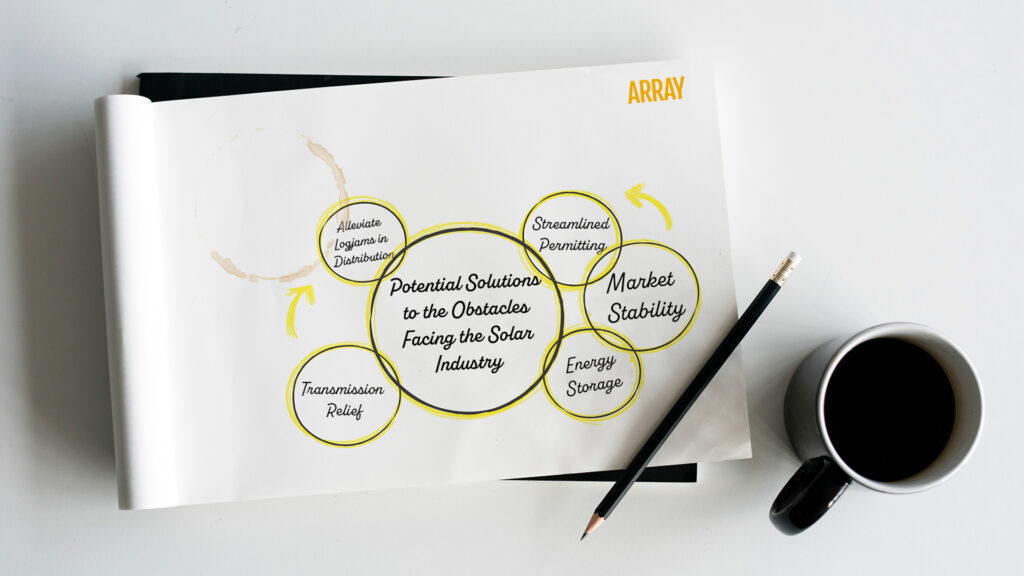  
 
Potential solutions to the obstacles facing the solar industry 
Long-term power purchase agreements between utilities and solar projects (PPAs) provide financial support to build out more renewable energy generation.ÔÇ»However, while PPAs may bypass spot market mechanisms, the power generated might not always be able to flow across the grid. This is usually due to infrastructure issues.┬á┬á
So how do we solve these threats to solar power? As a global provider of solar trackers, we at ARRAY take a broader, long-term view of these issues. We see solar curtailment as a pressing but relatively temporary concern.ÔÇ»┬á┬á
Three potential solutions are:ÔÇ»┬á
- ┬áImproving transmission and eliminating bottlenecksÔÇ»┬á
- Advancing current energy storage and developing new energy storage technologyÔÇ»┬á
- Improving market stabilityÔÇ»
ÔÇ»┬á
Transmission relief 
Grid weaknesses threaten to stymie the growth of renewable power. Curtailment is a symptom of the need for improved transmission, which is on the horizon, but it takes time to build out the grid.  
Grid operators, markets, and policymakers are responding to the demand for expanded transmission. For example, the Midwest Independent System Operator (MISO) recently approved 18 new transmission projects to support the shift to more renewables in the generation mix.  
MISOÔÇÖs grid spans allÔÇöor a portion ofÔÇö15 U.S. states and the Canadian province of Manitoba. The first of the new transmission projects is expected to come online in 2028. Prior to these recently approved projects, the last major transmission project in the MISO region was approved more than 10 years ago.ÔÇ»┬á┬á
Improved and expanded transmission will alleviate logjams in distribution, reducing the need for curtailment.  
 
Energy storage 
Expanding the use of storageÔÇöwhether batteries are deployed at the site of generation or distributed across the gridÔÇöcan provide an outlet when there is excess power. If more power is generated than is immediately needed, it can be saved for later when demand is high. This avoids wasting renewable energy and provides the opportunity to sell the power when it is needed rather than sell it below its value when itÔÇÖs not needed.┬á┬á
Thinking beyond the energy storage options we already have in place could also be a major piece of the energy mix puzzle. There are solutions that simply havenÔÇÖt been uncovered yet.┬á
Market stabilityÔÇ»┬á
Solar power expansion is a necessity for economic development and climate action. WeÔÇÖre hopeful that the growing recognition of local renewable energy as being vital to national energy security will spur further interest in clean energy manufacturing and technology innovation.ÔÇ»┬á
Our wish list for enabling more solar power covers many of the things we see as hugely important in achieving more market stability: 
- A stable and incentivizing regulatory┬á environment that will provide certainty for the long-term investments needed to expand renewable energy, including sustained tax creditsÔÇ»┬á
- Infrastructure enhancements to speed access to grid interconnection and to meet demandÔÇ»┬á
- Streamlined permitting for solar power projectsÔÇ»┬á
- Breakthroughs in battery technology to widen deployment of energy storageÔÇ»┬á
- Improved global trade transparency and reliabilityÔÇ»┬á
Better market stability will address all three of the hurdles discussed above. Interconnection delays will grow shorter with streamlined permitting, and negative pricing and curtailments will be alleviated by a more stable regulatory environment, infrastructure enhancements, and better storage.  
WhatÔÇÖs Next for the Renewable Energy Industry?┬á
Solar power is crucial for industrialized and developing countries to ensure access to emissions-free, reliable electricity. Technological and engineering breakthroughs have lowered the costs of photovoltaics, but now economic shortfalls and logistical roadblocks threaten further progress.
Thankfully, a growing number of investors, regulators, and consumers are sounding the call for clean energy. The industry is ready to build on its success and win over even more energy consumersÔÇöthe ultimate drivers of market forces.ÔÇ»┬á
In the meantime, weÔÇÖre continuing to develop new ways to make solar tracking both simpler and more sophisticated. By focusing on making solar sites as functional and productive as possible, weÔÇÖre doing our part to make our solar wish list come true.┬á┬á
The post 3 Major Hurdles to Solar Energy Growth (and 3 Solutions) appeared first on ARRAY Technologies.
]]>The post 5 Key IHS Markit Report Takeaways & Reflections appeared first on ARRAY Technologies.
]]>To save you the time of sorting through the comprehensive intel available, here are a few interesting things I took away from the IHS 2021 Global PV Tracker Market Report.
1. ARRAY TechnologiesÔÇÖ rising market share and growth
LetÔÇÖs start here. ItÔÇÖs exciting to see ARRAY has shown a 3% year-over-year increase in market share. ThatÔÇÖs the largest year-on-year increase in shipment volumes across the impressive (and vastly expanding) network of players in the PV tracker industry.┬áItÔÇÖs even more incredible when you consider the supply chain challenges that are reverberating all over the world.
The demand for trackers and utility-scale solar projects has been incredible in the last 18 months. The volume of centralized trackers increased 45% in 2020 compared to the previous year. This was driven mainly by shipments from ARRAY — In fact, we delivered 90% of the centralized shipments on a global scale in 2020.
ARRAY also saw a 5% gain in the Americas, which is currently the most mature market with a whopping 68% of global 2020 tracker shipments.
WeÔÇÖre also proud to be a major player in the rapid expansion of utility-scale solar development across Australia. This and other areas in the Asia Pacific region account for 26% (the third-largest share) of worldwide tracker installations within the forecast period.
2. Material costs (finally) in the rearview and looking to the future
At the risk of eliciting a groan for typing up the most understated (and over-written) sentence of the year2020 was a tough one. No industry or sector was completely untouched in one form or another from the global pandemic.
The PV solar business was no exception. Some of the most significant challenges included the surge in steel and freight prices, with a spike to more than double what they were in Q4 2020. Steel and aluminum commodities pricing climbed, and supply chains were challenged with demand and fluctuating costs.
ItÔÇÖs a complex problem and many elements contributed to it. But one major factor was the demand from consumers for more manufactured goods over services during the height of the pandemic, even while production capacity was also reduced due to pandemic restrictions.
With 2020 behind us, we recognize itÔÇÖs been a challenging time and weÔÇÖve adapted to meet customer needs. The good news is that prices are projected to normalize over the next several years.
Some of this will be thanks to supply chain stabilization and some will be thanks to continued module power output improvements and tracker technology developments over the next few years. Additionally, we continue to diversify our supply chain to meet global demand.
3. PV tracker intelligence will boost PV solar fiscal advantages
Tracker technology improvements are something weÔÇÖre working on every day. One of the ways we boost tracker tech intel is through our research and development center. You can read more about the collaboration and innovation happening at ARRAYÔÇÖs PV Tech Research and Development Center.┬áHaving our own solar site for customers and our own engineers helps us drive innovation every day.
The IHS report noted ARRAYÔÇÖs operation of dedicated PV solar training facilities on a global scale. We work with our customers and partners to solve industry challenges at the research center to drive improvements in installation, operation, and maintenance and overall solar advancement.
The report clearly spells out the importance of pushing forward for the best ideas in tracker technology. We pride ourselves on doing just that. With advancements like our industry-leading wind stability design for the DuraTrackÔôç Hz v3 and SmarTrack, our backtracking and diffuse lighting adaptability software, ARRAY is part of making the solar tracking industry more practical and financially rewarding.
4. The CAPEX/OPEX discussion
Another big takeaway from the report was a huge financial data point that has been coming to light and confirmed repeatedly by independent sources. This is on the important consideration between initial tracker cost, installation, and long-term operation and maintenance costs.
The IHS report states that ÔÇ£tracker products that have a higher cost may still enable developers to achieve savings on installation and maintenance versus other tracker products.ÔÇØ
ItÔÇÖs a big one that solar developers and site owners understand and are seeing payoff already. Third-party consulting and engineering firm RINA conducted a study on how investing in quality CAPEX can mean steadier, lower OPEX over time. You can read an executive summary of the comparative case study on PV OPEX vs. CAPEX and download the full report here.┬áLike the old saying goes, you do get what you pay for and our customers continue to enjoy a lower cost of ownership with an ARRAY system.
5. Lead with integrity, close with integrity
At ARRAY, we keep each other honest. Our engineers conduct research, and we stay open to customer and partner input. We donÔÇÖt assume we know it all. Our teams communicate openly with each other. We only publish claims we can stand by with confidence and integrity. That includes everyone from early product development all the way through to sales.
We take pride in our industry knowledge and don’t exaggerate our capabilities. We make sure we know the facts so that our customers can make the most informed decisions. From there, we make doubly sure through third-party validation and confirmation, and we keep pushing forward.
I am excited to see ARRAYÔÇÖs position in the report from IHS. Working collaboratively, consistently self-evaluating as a company, and staying honest are what allows us to cultivate so much more significant growth for our company, our investors, and the solar industry as a whole.
The post 5 Key IHS Markit Report Takeaways & Reflections appeared first on ARRAY Technologies.
]]>The post EverythingÔÇÖs Bigger in Texas, Including the Power Challenges appeared first on ARRAY Technologies.
]]>The massive Electric Reliability Council of Texas (ERCOT) grid distributes energy to the biggest state in the continental U.S. Through large-scale utility projects and tracker design options that meet individual site needs, ARRAY has helped solve some Texas-sized problems.
Step back and think about the fact that ERCOT holds its place among just two other power grids in the entire 48 lower states. The Lone Star State maintains its own grid to steer clear of federal oversight. ItÔÇÖs clear that Texas still has a little Wild West running through it.
However, the unique situation of ERCOT running an independent grid offers both advantages and disadvantages in terms of energy production and distribution. Solar is playing a part in smoothing out the disadvantages.
The State of Texas Utility Power 
In 2019, Texas saw a 13% increase in energy rates over the 2018 average while the rest of the country saw a decrease. It was a brutally hot summer that sent energy demands through the roof and tested the limits of the independent grid.
ERCOT delivers power to a large portion of Texas and, on occasion in the past, to other nearby grids. Through its history, the indie grid has sent power out to Oklahoma and imported power from Mexico during looming or active blackouts. This has led to messy legal issues and insecurity.
The good news is that things are changing. 2020 already looks better due to more renewables, including a significant increase in online solar.
Renewable Goals and LCOE
Despite being born of oil, Texas is now a state thatÔÇÖs embracing solar in the 2020s. Austin Energy and other utilities across the state have major goals for renewables. Austin is shooting for 65% renewables by 2027. Widescale solar is playing a major part in hitting those numbers.
At ARRAY, our focus is always on making more efficient systems and lowering the levelized cost of energy (LCOE) for project developers. Helping increase a projectÔÇÖs ROI means ARRAY helps create more clean solar energy in Texas and around the world.
Our thoughtfully designed trackers are populating one of the largest bifacial solar plants in the Americas (in Texas) along with many other design deployments to maximize sun capture in the Lone Star State. We have to say, it feels great to be part of the solution.
A fast-growing population and prosperous business environment challenges TexasÔÇÖs power grid, and severe weather events like hail, tornadoes, and flooding make logistics and construction challenging. On the other hand, Texas has so much space and access to transmission lines that in many ways it is ideal for major solar sites. Getting those sites up and running quickly and making sure they are secure in extreme weather (including wind and hail) is where ARRAY trackers really make all the difference for successful utility-scale developers and site owners.
How does contributing over 2GW of solar trackers to some of the most significant solar projects on the ground in Texas feel? It generates some Texas-sized feelings of pride.
Travis Rose, Vice President of SalesÔÇôNorth America for ARRAY Technologies, is both a Texas resident as well as a graduate of the University of Texas.
The post EverythingÔÇÖs Bigger in Texas, Including the Power Challenges appeared first on ARRAY Technologies.
]]>