The post Power Moves on Two Continents: Intersolar EU and CLEANPOWER 2025 Provide a Jolt of Energy for the Future of Solar appeared first on ARRAY Technologies.
]]>

Team ARRAY showed up in full force at Intersolar Europe, connecting with industry leaders and showcasing how our end-to-end solutions—from supply chain to site design—deliver unmatched value for utility-scale solar projects.
Intersolar Europe: Smarter Tracking for a Global Market
At Intersolar Europe in Munich, ARRAY introduced the enhanced ARRAY STI H250 , now equipped with ARRAY SmarTrack® for backtracking and diffuse light optimization. These upgrades reflect what developers around the world are looking for: tools to improve energy yield and reduce exposure to weather-related losses—especially in complex terrains and variable climates.
We had the chance to speak with international EPCs and partners about how SmarTrack’s automated capabilities can help mitigate shading, improve project bankability, and support long-term asset performance. The feedback confirmed what we’ve been hearing globally: utility-scale solar isn’t slowing down, and smart technology that reduces risk is no longer optional—it’s expected.

Jessica Lawrence-Vaca and MJ Shiao on stage during the “Clean Energy Manufacturing: The Great American Comeback” panel at CLEANPOWER.
ACP CLEANPOWER 2025: Manufacturing, Policy, and the Path Ahead
Back stateside in Phoenix, the conversation shifted to U.S. policy and domestic content. During the “Clean Energy Manufacturing: The Great American Comeback” panel hosted by ACP’s MJ Shiao, I had the opportunity to discuss ARRAY’s new Albuquerque manufacturing facility and our expanded domestic supply chain.
ARRAY is now offering 100% U.S. domestic content trackers under Table I for delivery in 2025, built with U.S. steel and components sourced through trusted domestic partners. A milestone that reflects both our investment in American manufacturing and our commitment to meeting customer and policy expectations head-on.
Meanwhile, ARRAY engineers Mudassar Zahoor and Sumanth Varma Lokanath presented on our latest wind and hail stow strategies, a critical area of innovation as weather volatility rises. Their presentations highlighted how smart engineering—not just regulation—is key to long-term project resilience.
Whether at our booth or during in-depth conversations with attendees, the excitement was palpable. Developers, insurers, and investors were all asking how policy, product, and performance are converging—and what that means for the next generation of solar.
What These Events Show Us
From Europe to the U.S., we saw firsthand that the energy transition is global—but the challenges are local. Projects need solutions that perform under pressure, on any terrain, and in any regulatory environment.
At ARRAY, we’re delivering that flexibility through decades of experience, a growing global footprint, and field-proven innovation. Whether it’s high-wind sites in Texas, hail-prone regions in Australia, or terrain-adaptable layouts in Brazil, we’re focused on helping our partners unlock more energy, more safely—with fewer tradeoffs.
The post Power Moves on Two Continents: Intersolar EU and CLEANPOWER 2025 Provide a Jolt of Energy for the Future of Solar appeared first on ARRAY Technologies.
]]>The post Key Takeaways from RE+ 2024: Innovation and the Future of Solar appeared first on ARRAY Technologies.
]]>This year, ARRAY showcased some of our latest advancements, including the new ARRAY DuraTrack with SkyLink & ARRAY OmniTrack with SkyLink and the highly anticipated 77° tracker, which promises to set new benchmarks for hail protection and wind mitigation.
I was able to experience the event as both an exhibitor and a speaker and I wanted to share my top takeaways from the week, which I believe will have a lasting impact on the solar industry.

ARRAY’s 77° Tracker: Setting New Standards in Hail Protection
We kicked off the week by announcing our groundbreaking 77-degree stow capability, a feature that sets a new benchmark in hail protection for solar tracker systems. As weather patterns grow increasingly unpredictable and insurance companies raise their standards for risk management, our industry needs to be proactive in safeguarding solar assets.
The 77-degree high-tilt tracker is designed with this in mind and will offer superior protection not only against hail but also high winds. The integration of our proven ARRAY SmarTrack Hail Alert Response software allows solar panels to stow quickly and effectively before a hail event strikes, reducing the potential for damage and safeguarding valuable investments.

Sustainability on Display: Our Reusable Packaging Initiative
RE+ also gave us the opportunity to spotlight another important innovation—our new reusable packaging solution. Designed to reduce waste and enhance efficiency, this packaging reflects our commitment to sustainability and streamlining supply chain operations.
By replacing traditional cardboard with durable plastic casing, we’re enabling our customers to reduce their environmental footprint while improving logistics. With the potential to last up to 15 years, this packaging innovation significantly reduces the number of trucks required for transport and cuts labor costs associated with material handling.
The overwhelmingly positive feedback from our customers highlights the industry’s growing focus on sustainability—not just in the energy produced but in every aspect of the supply chain.

ARRAY team visiting the ASGA booth.
Agrivoltaics: Merging Solar and Agriculture
Another standout moment from RE+ was seeing the growing interest in agrivoltaics—an exciting intersection of the solar industry with agricultural practices. Agrivoltaic practices, such as solar grazing, offer a winning solution for managing vegetation while maximizing land use and creating new revenue streams for farmers and agricultural communities.
At the conference, we were fortunate to have our solar trackers featured in a live agrivoltaic demonstration in collaboration with the American Solar Grazing Association (ASGA). This demonstration, showcasing sheep grazing beneath solar panels on our ARRAY STI H250 solar tracker, highlighted the potential of agrivoltaics to reduce the need for mechanical mowing and herbicides, all while benefiting local farmers.
The conversations sparked by this display underscored the exciting potential for agrivoltaics to scale across the industry, enhancing both sustainability and community engagement in solar projects.

Jessica Lawrence-Vaca (CENTER) speaking as part of the the “Integrated Insights Across U.S. Manufacturing and Energy Supply Chains” panel.
Looking Ahead: Expert Insights from U.S. Manufacturing Leaders
Personally, one of the best parts of RE+ was the chance to engage with thought leaders and policymakers on the key challenges and opportunities facing our industry. As a panelist on the “Integrated Insights Across U.S. Manufacturing and Energy Supply Chains” panel, I had the honor of representing ARRAY as the original American solar manufacturing success story and discussing these critical issues alongside experts (and friends) such as Justin Baca from SEIA, Cora Dickson from the U.S. Department of Commerce, Kelly Speakes-Backman from Invenergy, and Arthur Haubenstock from the U.S. Department of Energy.
The conversation highlighted the pressing need to strengthen domestic manufacturing and the importance of supply chain resilience, especially as demand for solar products continues to rise. While the Inflation Reduction Act (IRA) has given a significant boost to U.S.-based solar manufacturing, challenges such as tariffs and supply chain bottlenecks persist. At ARRAY, we are committed to working closely with policymakers to ensure that the regulatory environment supports the growth of domestic manufacturing, job creation, and community development. Please see the article in Utility Dive to go deeper into the conversation.
RE+ 2024 was a powerful reminder of how far the solar industry has come—and how much potential we have yet to unlock. From the unveiling of ARRAY’s 77° tracker to our commitment to sustainability through initiatives like reusable packaging and agrivoltaics, our industry is innovating at an unprecedented pace. However, to realize the full potential of these advancements, we must continue to foster collaboration across sectors, from government and industry to local communities.
The insights and discussions from RE+ 2024 will undoubtedly help us navigate this dynamic and rapidly evolving landscape, propelling us toward a more sustainable and resilient energy future. By leveraging innovation, partnerships with our customers and industry partners, and sound policy support, ARRAY is well-positioned to continue leading the charge toward a cleaner, more reliable energy grid.
The post Key Takeaways from RE+ 2024: Innovation and the Future of Solar appeared first on ARRAY Technologies.
]]>The post Solar Developers and Tech Innovators Adapt to Policy Changes appeared first on ARRAY Technologies.
]]>It was such a great conversation. You can watch the full webinar embedded below or keep reading for some key takeaways from our discussion, including:
- recent changes in U.S. policy concerning utility-scale solar,
- guidance needed to unleash progress,
- thoughts on module availability,
- future of solar development,
- challenges surrounding severe weather, and
- some great questions from attendees.
Recent changes in U.S. policy concerning utility solar
The passing of the Inflation Reduction Act (IRA) will help stabilize supply chain issues over the long run, creating increased optimism in developers and financiers.
Wood Mackenzie reported a 29% decrease year over year in deployment of utility-scale solar from 2021 to 2022.
Sylvia shared that two reasons for this are:
- The Uyghur Forced Labor Prevention Act (UFLPA)
- Start of an anti-circumvention investigation by the US Department of Commerce
These factors led to several gigawatts (GW) of modules being detained by Customs and Border Protection, and many projects were pushed to 2022 and 2023. These factors will continue to affect the industry in the short term, but analysts at Wood Mackenzie are confident they will work out in the long term.
Further guidance needed to unleash progress
Developers are trying to choose between the Production Tax Credit (PTC) and Investment Tax Credit (ITC) tax credit transferability, among other variables. Like how steel will be treated under the ITC, or what qualifies as “domestic source” for different materials, to name a few. Knowing which variables—or combination of variables—can be implemented can change each site’s projected revenues.
That’s why federal entities need to provide further guidance on various requirements. This guidance will help even out the supply-and-demand imbalance and fill in tax planning gaps for financing solar projects.
Thoughts on module availability
As suppliers fall in line with UFLPA compliance, production should ramp up this year or early in 2024. This will help stabilize the supply-and-demand imbalance.
Customers must look at designs with multiple modules because they can’t secure modules, or the modules may fall through. It’s been a challenge from a project timing perspective.
From a design and planning perspective, ARRAY works with customers who ask us to model around different module types because it’s possible they’ll get partials, or the modules may change.
We’ve seen demand for this kind of design go up exponentially. So, we’ve automated the way we do our designs to keep up with customer needs while ensuring the same quality of review for each design.
One ARRAY DuraTrack® advantage is that it’s fully module agnostic. By not predrilling holes in the tracker torque tube, it’s able to fit any specific module currently on the market. This allows us to confidently design around multiple modules knowing that the core bill of materials for the tracker won’t change.
Future of solar development: a prediction for next 3–5 years
From a developer’s standpoint, there’s no shortage of off-taker customers, but projects in ideal locations with flat, even land in mostly sunny places are less available. We need to continue to find cost-effective solutions to deal with ever-more-challenging terrain and subsurface conditions including the introduction of our new flexible terrain tracker, the ARRAY OmniTrack.
This new tracker allows one degree more flexibility in the north-south slope change with the torque tube. That allows our customers to cut down on costly grading and maintains the site’s natural foliage for a less invasive installation.
At ARRAY, we’re continuing to prioritize lower lead times and consistent deliveries for customers. We’ve expanded and locked in our logistics carrier and have alternatives in place if congestion issues arise.
We’ve expanded our supply base with multiple options, so we’re not relying on a single source. Not only are we able to do some of the manufacturing in-house, but we have manufacturing and suppliers around the world. Our global supply plan is essential to our ability to respond quickly to the unexpected.
Challenges surrounding severe weather
Large hail and 50-year winds are occurring more frequently, causing problems with the insurability of many sites. The entire industry needs to address this reality and develop technological solutions rather than addressing it through insurance alone.
Where other tracker companies fall short is that they rely on a lower angle degree stow position for wind, which is not necessarily best for hail. ARRAY’s wind mitigation position occurs at the highest tilt level, 52°, which is also optimal for hail. Using ARRAY SmarTrack software, this mitigation can happen remotely or manually to help protect our customer’s sites.
For projects in the North and Midwest U.S. regions, our SmarTrack system also has an active stow response in case of snow. It detects snow and moves to 52°. Once enough snow melts, it moves the tracker back to normal tracking with no damage to the modules.
Audience Question:
For tracker evaluation, have the operation and maintenance (O&M) needs been considered when comparing them to fixed-tilt racking?
Art shared that 15 years ago, EDF was nervous about trackers because of the O&M component. Now, most of EDF’s sites use trackers, and two of the reasons include:
- trackers have led to better production, and
- the ability to move and stow trackers during severe weather far outweighs any potential O&M costs.
Our goal with DuraTrack is zero maintenance. This includes design features like sealed gear boxes that don’t require lubrication and parts that are tested for the lifetime of the site. With their improved reliability, increased throughput, and the low cost of ownership of trackers, our trackers are more advantageous compared to fixed-tilt systems even in the kilowatt range.
ARRAY’s perspective on the Inflation Reduction Act (IRA) and the future
As Sylvia said during the webinar, “The panorama looks bright for solar despite the challenges around needing clarity from the IRS.”
The IRA is intended to drive interest in renewables—solar in particular—and create more U.S. jobs. So, it’s a good thing, but it’s complicated to navigate right now.
Creating a U.S.-based supply chain from scratch has been challenging for many companies. Thankfully, at ARRAY, we’ve been building our strong U.S. supply chain for 30+ years, which reduces risk for developers.
However, the government still needs to provide information on what is required for traceability to the entire industry. With that understanding, we can help customers and capitalize maximally on Solar Investment Tax Credit (ITC) benefits.
Overall, it’s an exciting time but also challenging. Everyone is ready to go and waiting for that starter pistol of clarity to go off.
Sign up below and be the first to know about ARRAY’s next webinar!
The post Solar Developers and Tech Innovators Adapt to Policy Changes appeared first on ARRAY Technologies.
]]>The post 3 Questions Investors Have About ESG Answered appeared first on ARRAY Technologies.
]]>ESG initiatives are based on values from within the company. These companies act conscientiously to improve the environment, their employees’ lives, and how they run their organizations.
Consumers and investors worldwide are paying more attention to ESG factors when making investment decisions. A 2022 Capital Group study revealed that approximately 89% of investors integrated ESG issues into their investment approach. Even oil and gas companies are investing in renewables. British Petroleum’s ownership stake in Lightsource, a solar and wind developer, is but one of many signs that the energy transition is happening.
So, here are some of the common ESG questions investors ask:
- How can I trust that a company follows ESG practices if there’s no universal standard and it’s all self-reported?
- ‘Positive change’ in governance and hiring can be subjective, so how can an investor evaluate positive change?
- Is investing in ESG companies risky because the funds won’t be in diverse funds/portfolios?
How can I trust that a company follows ESG practices if there’s no universal standard and it’s all self-reported?
First, consider what third-party reporting agencies say about the ESG company you’re interested in investing in. Start with the Global Reporting Initiative (GRI), the Sustainability Accounting Standards Board (SASB), and the Task Force on Climate-Related Financial Disclosures (TCFD) to triangulate the information they’ve each gathered because they all measure slightly different things related to ESG.
Second, look at the ESG initiatives and reporting the company offers on its website. Does the company operationalize around ESG and consistently report on it?
At ARRAY, we regularly provide a forum to answer ESG-related questions. Investors—and potential investors—can dial into quarterly earnings calls, which are open to the public. So, if investors have questions and can’t find the information they’re looking for, they can ask us directly.
‘Positive change’ in governance and hiring can be subjective, so how can an investor evaluate positive change?
First, think of “positive change” as “fair and equitable change.”
For example, increased hiring of diverse candidates and under-represented groups is just good business. The company not only recruits people from different backgrounds and with varied talents but also gains diversity of thought across the organization.
Another place where fair and equitable comes into play is the pay gap between men and women. Companies can address this head-on to drive retention and effective succession planning.
Diversity isn’t about checking a box—it requires a discipline that an organization might not be exercising. A company that starts with a diverse slate of candidates increases the odds of a diverse employee population. With a diverse candidate slate for every position, your company creates the opportunity to hire the most qualified person for the role.
Ultimately, shareholders want companies to hire and retain the best person for each position. Someone well matched for a position will get results and add value to the company. At ARRAY, we are ensuring that we start with diverse candidate slates from the time that we open a role, so that we have a better chance of hiring.
Will investing in ESG funds perform at similar rates as non-ESG funds?
Doing well while doing good is absolutely possible. When the NYU Stern Center for Sustainable Business and Rockefeller Asset Management examined the relationship between ESG and financial performance in more than 1,000 research papers published between 2015 and 2020, they found “a positive relationship between ESG and financial performance for 58% of the . . . studies.”
Being aware of the environment and suppliers, hiring diverse people, and having an independent board are all factors that make a company a more solid investment. They show that the organization is well run and mindful.
Investors increasingly want to invest in companies that report ESG data, so transparency is key. Companies that provide transparency come out ahead of companies whose ESG actions are unclear.
ESG should not pit profit against doing the right thing as a company. It is possible—and proven—that companies can do well in your financial portfolio while positively contributing to the environment around them, the communities they serve, and the employees who help make it all happen.
No investment is ever a guarantee. Investments must be thought of as long-term commitments, not as quick wins. Investing is about aligning with your values and investing long term in the planet.
How ARRAY is achieving its ESG goals
At ARRAY, we think of ESG as the way we run our business. We operationalize around the goals we put in place for 2025 and have working groups for each goal. We’re not working simply to get better scores or to put out a report—we want to be better as a company.
We list our policies on our website, and all our suppliers sign a code of conduct that speaks to antislavery, anti-bribery, and anti-child labor. We align ourselves with like-minded suppliers that are committed to making the same changes we do.
Many people choose to work at ARRAY because they want to be in the renewable space, and ESG and renewables go hand-in-hand. This purpose-driven culture attracts employees who not only want to do great work, but want to change the world while doing it.
Between our 2021 diversity baseline and 2025, we want to increase female representation in our workforce by 10%, racial and ethnic minority representation in our nonexecutive management by 10%, and female representation on our board by 22%. Impressively, we have already reached our board diversity goals by adding another woman, Tracy Jokinen, to our board of directors.
Perhaps the most rewarding and the most challenging is that the change we are driving through ESG requires a cross-functional team that works towards shared goals. When we published our first full-year 2020 report, we all rejoiced because everyone was so invested. It has been having this shared vision and a culture of continuous improvement that continue to drive us forward, getting better each year.
As a newly public company, it felt good to get an ESG report out within a year (and some change) of going public, but it was an incredibly heavy lift. It helped us grow exponentially as a company, and it was incredible for everyone to rally behind and celebrate it. Now that we are working on our third one, there is a sense of confidence around what we are tackling, but also a willingness to bring forward new ideas to drive progress.
As a company that is deeply engrained in the energy transition and renewable energy, we continue to look to the future, despite the many challenges ahead. At ARRAY Technologies, it is in our DNA to generate energy with integrity for a sustainable world.
Read more on our ARRAY Technologies investors relations page.
SIGN UP TO BE NOTIFIED WHEN OUR 2022 ESG REPORT IS AVAILABLE
The post 3 Questions Investors Have About ESG Answered appeared first on ARRAY Technologies.
]]>The post 3 Major Hurdles to Solar Energy Growth (and 3 Solutions) appeared first on ARRAY Technologies.
]]>
Obstacles to the growth of solar energy
There are three major hurdles:
- Grid interconnection delays
- Negative pricing
- Solar curtailments
What could cause delays in grid interconnections?
North America has two major—and three minor—power grids, or “interconnections.” Every new utility-scale solar site must request connection to these grids. At this point, they enter whatas’s known as the “generator interconnection queue.” This queue consists of four stages:
- The project developer initiates the interconnection request
- The necessary interconnection studies begin
- The utility and generation owner negotiate the interconnection agreement
- Commercial operation starts
Projects can spend years waiting in this queue, with some assessments finding 3.7 years to be the typical time required for generation projects to complete the interconnection request process and begin commercial operations.
What does negative pricing mean?
Negative pricing happens in the spot markets when demand for solar energy is low andor supply suddenly increases. It can force renewable power plants to give away electricity or even pay distributors to take it. If the price goes negative, developers cannot recoup the costs of building their solar projects and are therefore less inclined to build projects where negative pricing is a possibility.
For reference, spot markets are “a commodities market in which the commodity is sold for cash and is delivered to a specific location for a specific time period that occurs on the day of the sale or on the day after the sale.”
When are solar curtailments used?
Excess renewable energy supply can also lead to curtailment. This is when operators or utilities require reduced solar energy from generators as a way of reducing transmission congestion. Sometimes curtailment goes so far as to completely shut down generation from a project for a period of time, wasting the solar energy that could have been produced.
Negative pricing and solar curtailments occur worldwide. One recent example of curtailment happened in Spain. Curtailment caused by insufficient energy transmission—failure to move enough power from renewable generators to locations needing power—has also occurred frequently in Texas, a leader in wind and solar power installations.

Potential solutions to the obstacles facing the solar industry
Long-term power purchase agreements between utilities and solar projects (PPAs) provide financial support to build out more renewable energy generation. However, while PPAs may bypass spot market mechanisms, the power generated might not always be able to flow across the grid. This is usually due to infrastructure issues.
So how do we solve these threats to solar power? As a global provider of solar trackers, we at ARRAY take a broader, long-term view of these issues. We see solar curtailment as a pressing but relatively temporary concern.
Three potential solutions are:
- Improving transmission and eliminating bottlenecks
- Advancing current energy storage and developing new energy storage technology
- Improving market stability
Transmission relief
Grid weaknesses threaten to stymie the growth of renewable power. Curtailment is a symptom of the need for improved transmission, which is on the horizon, but it takes time to build out the grid.
Grid operators, markets, and policymakers are responding to the demand for expanded transmission. For example, the Midwest Independent System Operator (MISO) recently approved 18 new transmission projects to support the shift to more renewables in the generation mix.
MISO’s grid spans all—or a portion of—15 U.S. states and the Canadian province of Manitoba. The first of the new transmission projects is expected to come online in 2028. Prior to these recently approved projects, the last major transmission project in the MISO region was approved more than 10 years ago.
Improved and expanded transmission will alleviate logjams in distribution, reducing the need for curtailment.
Energy storage
Expanding the use of storage—whether batteries are deployed at the site of generation or distributed across the grid—can provide an outlet when there is excess power. If more power is generated than is immediately needed, it can be saved for later when demand is high. This avoids wasting renewable energy and provides the opportunity to sell the power when it is needed rather than sell it below its value when it’s not needed.
Thinking beyond the energy storage options we already have in place could also be a major piece of the energy mix puzzle. There are solutions that simply haven’t been uncovered yet.
Market stability
Solar power expansion is a necessity for economic development and climate action. We’re hopeful that the growing recognition of local renewable energy as being vital to national energy security will spur further interest in clean energy manufacturing and technology innovation.
Our wish list for enabling more solar power covers many of the things we see as hugely important in achieving more market stability:
- A stable and incentivizing regulatory environment that will provide certainty for the long-term investments needed to expand renewable energy, including sustained tax credits
- Infrastructure enhancements to speed access to grid interconnection and to meet demand
- Streamlined permitting for solar power projects
- Breakthroughs in battery technology to widen deployment of energy storage
- Improved global trade transparency and reliability
Better market stability will address all three of the hurdles discussed above. Interconnection delays will grow shorter with streamlined permitting, and negative pricing and curtailments will be alleviated by a more stable regulatory environment, infrastructure enhancements, and better storage.
What’s Next for the Renewable Energy Industry?
Solar power is crucial for industrialized and developing countries to ensure access to emissions-free, reliable electricity. Technological and engineering breakthroughs have lowered the costs of photovoltaics, but now economic shortfalls and logistical roadblocks threaten further progress.
Thankfully, a growing number of investors, regulators, and consumers are sounding the call for clean energy. The industry is ready to build on its success and win over even more energy consumers—the ultimate drivers of market forces.
In the meantime, we’re continuing to develop new ways to make solar tracking both simpler and more sophisticated. By focusing on making solar sites as functional and productive as possible, we’re doing our part to make our solar wish list come true.
The post 3 Major Hurdles to Solar Energy Growth (and 3 Solutions) appeared first on ARRAY Technologies.
]]>The post 2022 Company Highlights & What’s in Store for ARRAY Technologies in 2023 appeared first on ARRAY Technologies.
]]>Not only was 2022 a busy and eventful year for ARRAY, it was a momentous time for the industry as a whole. So, I’d like to share some of my favorite highlights, and a sneak peek at what’s in store for ARRAY in 2023!
Recognizing Those Who Makes ARRAY Shine Every Day
My first 2022 highlight has to be getting to know all the amazing ARRAY team members around the globe. There are more than 1,300 dedicated professionals working hard every day to serve our clients and advance our bold vision for the future of clean energy.
From the machine operators and quality technicians at our manufacturing sites in New Mexico, U.S.A., São Paulo, Brazil, and Badajoz, Spain to our engineers, order fulfillment specialists, and service teams in our regional offices around worldwide, thank you.
I am sincerely grateful to all of you and your commitment to changing the trajectory of climate change, and I’m proud of what we’ve accomplished in 2022.
Check Out Open Positions at ARRAY
We Took a Good, Long Look at Ourselves
The year of 2022 began with the exciting completion of the acquisition of STI Norland in January, but with all the potential combining our companies offered, we couldn’t simply fold STI Norland into ARRAY and move on with business as usual. We don’t want to just be a global leader in the solar tracker industry, we want to be a leader in the renewable energy industry with a rich heritage, strong global presence, diverse product line, and a passion for serving customers, employees, investors, and the planet.
So, from the moment I started as ARRAY’s CEO in April, it’s been my mission to truly integrate our two strong organizations and create a powerful new force in the clean energy industry—one company with a full range of products and solutions.
One crucial element to the integration has been evaluating and adapting our mission and values to where ARRAY is heading in the future. As we continue to expand globally, our commitment to our improved mission and values will differentiate us from our competition and guide our company culture.
It’s been exciting to see the progress so far and I look forward to completing the integration in 2023.
ARRAY Continues to Grow in the U.S. and Abroad
ARRAY’s ability to deliver excellent service and superior products on a global scale continues to be unmatched, thanks to our team’s innovative solutions. We have a lot to be proud of, but here are a few highlights from 2022:
- ARRAY’s global capacity to serve the market increased by more than 25% and can deliver over 30 gigawatts annually.
- With over 20 existing U.S. supplier partnerships—and the addition of new suppliers already in the queue—we expect deliver capabilities to be near 40 gigawatts by the end of Q1 2023.
- We won several new projects that will generate clean power for generations to come, thanks to our diversified global supply chain and customer-centric approach.
- ARRAY launched new products such as OmniTrack, introduced the STI-H250 to new markets, and worked on innovations that will propel our growth in the years ahead.
- We strengthened our commitment to our environmental, social and governance (ESG) and diversity and inclusion priorities.
Public Policy and the Renewable Energy Sector
The recent passage of the Inflation Reduction Act, which I was able to celebrate on the White House lawn—includes large subsidies across the entire solar supply chain, that will accelerate the transition to renewable energy sources—like solar projects—in the United States. However, the IRA provisions state that to get the full subsidy, a solar project must use U.S. products. Making the underlying source of steel a crucial factor for our customers as they look to meet the IRA’s domestic content requirements.
Not only does ARRAY utilize U.S. steel mills, but we also have suppliers that source steel from the U.S. Thanks to our large—and well-established—U.S. supply base and our asset-light operating model, we have the shortest and most reliable lead times in our industry. Even better is that our customers trust in our ability to deliver the right products and services for their projects on time.
This has been a monumental year for me, both personally and professionally. I am grateful for the opportunity to lead ARRAY at this pivotal time, and I look forward the new opportunities 2023 will bring. One thing is for sure: working closely with our partners and clients, ARRAY will continue doing our part to advance the clean energy future our citizens demand and our world deserves.
The post 2022 Company Highlights & What’s in Store for ARRAY Technologies in 2023 appeared first on ARRAY Technologies.
]]>The post ARRAY in the News: 2023 Starts off Strong with Recognitions & Positive Financial Reporting appeared first on ARRAY Technologies.
]]>

ARRAY Alongside Primergy Solar Announced as Finalists for The Cleanie Awards 2022 Project of the Year—People’s Choice for Gemini Project
Focused on honoring innovators, accelerators, and disruptors who are creating market-moving climate solutions, The Cleanie Awards is the only cleantech industry awards program. The Project of the Year is awarded to projects that add tremendous community value.
The Gemini project is set to be the largest operational solar + storage project in the United States and one of the largest in the world when it is completed in 2023. ARRAY is proud to be supplying nearly 1GW of DuraTrack® single-axis solar trackers for the Gemini project led by Primergy, a company focused on investing in responsibly-sited solar and energy storage projects and has enlisted a consortium of solar industry leaders to build and maintain the project.
Voting is open until February 10, 2023, and at the time of posting, ARRAY and Primergy are in second place with a combined 44,562 votes.
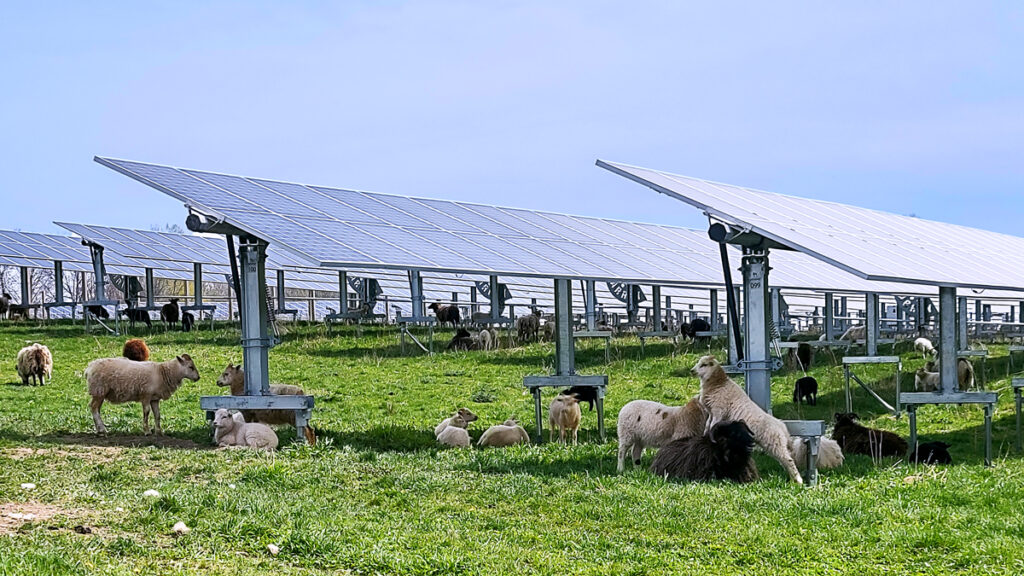
Photo credit: Highland Grazing, a United Agrivoltaics farm partner.
ARRAY Named One of America’s Most Responsible Companies 2023
Corporate responsibility isn’t just a buzzword here at ARRAY—it’s a cornerstone of our company and what helps make us a trusted, reliable choice for solar trackers and solar technology.
Newsweek partnered with Statista on its fourth annual list of America’s Most Responsible Companies, which honors organizations—including ARRAY—that strive for true excellence in terms of their treatment of customers and employees as well as the environment around them. This comprehensive ranking is an effort to recognize companies with a genuine commitment towards aligning business practices with ethical values and encourage more corporations to prioritize corporate social responsibility.

Yahoo!finance Includes ARRAY as Clean Energy Stock to Watch
In a recent article published on Yahoo!finance, an analyst said they “love” ARRY stock. The article highlighted five clean energy stocks they say play to the themes Morgan Stanley believes will impact clean technology in 2023, including:
- Focus on profitable growth and path to profitability,
- IRA benefits materializing later than expected,
- Supply chain easing in battery storage, driving strong growth and improved pricing,
- Inflationary utility bills and deflationary distributed generation, and
- Project announcements in green hydrogen.

Solar Power World Interviews Erica Brinker on Upgrades to Single-axis Trackers
Our Chief Commercial Officer and Head of Environmental, Social & Governance (ESG), Erica Brinker, recently sat down with Solar Power World’s Billy Ludt to discuss single-axis solar trackers and how they’re changing. In the article, Erica shares insights into why we developed our latest product, the ARRAY OmniTrack, and says, “Some of the very progressive developers globally, they don’t want to disrupt the topography, they don’t want to change the environment.”

Nasdaq Shares That The Zacks Analyst Blog Highlighted ARRAY
Recently Nasdaq shared a press release from Zacks, a leading investment research firm focusing on stock research, analysis and recommendations. In this release, an analyst includes ARRAY Technologies as of one of four solar stocks seeing “explosive growth.” The analyst goes on to share that due to governments attempting to speed up the switch to renewables, there’s huge demand for solar panels and related components—giving ARRAY a “Growth Score of A.”
At ARRAY, we’re always striving to be at the forefront of clean energy technology and innovation. We’re proud to see our efforts being recognized by some of the most respected names in solar power and finance, and we’ll continue doing everything we can to push the boundaries of what’s possible in renewable energy.
If you want to stay up to date on all things ARRAY, be sure to check out our press releases and blog and follow us on Twitter and LinkedIn. Thanks for supporting our mission of generating energy with integrity for a sustainable world!
The post ARRAY in the News: 2023 Starts off Strong with Recognitions & Positive Financial Reporting appeared first on ARRAY Technologies.
]]>The post Arizona Business Leaders Rally Behind the Build Back Better Act appeared first on ARRAY Technologies.
]]>Click here to read about the Arizona Technology Council press conference, view the clip below to watch the live event, or scroll down to read Erica Brinker’s remarks:
Remarks from Erica Brinker:
My name is Erica Brinker and I am the Chief Marketing Officer and Head of ESG at ARRAY Technologies. We are not only excited to represent utility-scale solar, but also our growing presence in Arizona.
ARRAY Technologies is the world’s largest utility-scale solar tracker technology company. We were founded more than 30 years ago as a company focused on building hardware and software technology engineered to enhance utility-scale solar productivity. We have operations in 7 cities around the world and serve customers in 51 countries.
Just last year, we went public, listing on the NASDAQ and have continued building out our corporate presence in the greater Phoenix area, taking advantage of Arizona’s most abundant natural resource – sunshine.
Earlier this year, we announced the launch of the ARRAY Technology Research Center located in Tempe. At the Center we test the latest in solar tracking advancements. Our growth has been so explosive that we are even moving into larger offices to accommodate more employees AND to support the incredible demand by our customers.
While we are extremely proud to be part of the clean energy revolution, we also think this is just good business and an industry worth investing in. The state’s support for businesses and its communities is a major factor to why we have chosen to expand our presence here in the state.
ARRAY Technologies continues to invest in Arizona and that is one of the reasons I am so excited to discuss what the Build Back Better Act means to companies and employees like ours.
Today, more than 300 companies and more than 7,300 people already have jobs in the solar power industry in the state of Arizona.
If passed, the Build Back Better Act, will create incentives to encourage businesses to enter or support the solar industry, increasing the number of high paying and living wage jobs in Arizona.
We already have an idea of the impact that this legislation could have. Since a similar support was enacted in 2006, called the ITC, the U.S. solar industry has grown by more than 10,000% – creating hundreds of thousands of jobs, investing billions of dollars in the U.S. economy in the process.
The Build Back Better Act includes more than $500 billion in investments for clean energy and environmental justice – including over $300 billion to expand and extend clean energy tax incentives.
These tax incentives have the power to unleash the clean energy economy utilizing a proven policy to ensure that America’s solar development continues to shine.
From our point of view, a vibrant solar industry is a bloodline for emerging clean energy sources including new technologies like battery storage.
The policies in the Build Back Better Act provide a strong signal to the world that the United States intends to be a leader when it comes to diversifying our energy sources and supporting clean energy. And Arizona is perfectly poised to capitalize on investments in the solar industry.
Thank you so much for your time today and I look forward to continuing the conversation about how we can work together to support the clean energy industry and, in turn, create more economic opportunity in Arizona. We don’t see the Build Back Better Act as a political matter. It’s just good business. Let’s work together to do well while also doing good.
The post Arizona Business Leaders Rally Behind the Build Back Better Act appeared first on ARRAY Technologies.
]]>The post America’s Solar Energy Agenda for 2050: Our Wish List to Make It Reality appeared first on ARRAY Technologies.
]]>The Biden administration recently announced a goal to produce 45% of US power from solar sources by 2050. To give some perspective, currently, solar power is under 4% of the US power grid but has accelerated at record rates over the past decade.
A blueprint to ramp up and meet these ambitious goals was outlined by the Department of Energy (DOE), projecting that solar power installation would have to be doubled over the next four years, then doubled again by 2030. Put another way, that means installing 30 gigawatts per year of solar capacity between now and 2025, and another 60 GW a year between 2025 and 2030.
That may seem daunting, but the utility-scale solar industry continues to grow at a breakneck pace. In order to reach these ambitious goals, we need to do something much differently than what got us to this point.
Ambitious Energy Goals – Can It Be Done?
After absorbing the DOE Solar Futures study, we do think that solar could ultimately make up 45% of total power generation in the US by 2050. With one massive caveat—you can’t get there without utility-scale solar. This conclusion is also supported throughout the DOE’s report. In other words, rooftop solar alone will not be enough.
This isn’t meant to dimmish the importance of rooftop solar—we support all the many ways solar can power the world with clean energy. But in order to make the massive shift to clean energy and move to a more carbon-neutral scenario, utility-scale solar deployments will be a necessity. And the price of solar has dropped 70% over the last 10 years, making it an ever-attractive and efficient way to deploy clean energy. A government-backed solar proclamation isn’t enough to make it a reality.
There will be lots of challenges, and it will require Herculean efforts like federal investment and major policy change. Unfortunately, money and policy will not be enough. Increasing utility-scale solar capacity will require incredible coordination with utilities, private and public investors, regulators, and more.
Even with all of these challenges, the possibilities of inexpensive, clean energy and ultimately a chance to substantially reduce carbon emissions by 2050 is real—and a future we are excited about. As we look at what is possible for utility-scale solar, there are essential actions that must be taken to clear the way for the short and long-term challenges that lie ahead.
The Biden’s administration’s announcement was a headline we were excited to read, but one that must be coupled with complementary action to drive change. Here are our six wishes to make the 2050 solar goals a reality:
- Creation of a stable regulatory and incentive environment so that the industry can make long term commitments to funding and capital
- Enhancement to the aging power grid so that there are fewer disruptions and consistent power delivered to homes and businesses across the US
- Streamlined permitting for solar so new sites can be identified and deployed faster
- Investment in battery storage technologies which will help to smooth the output of power
- Develop productive trading relationships with international module manufacturers so there is diversity in the supply chain
- Deployment of tax credits. Reuters reported 700+ companies requested long-term extensions of a solar investment tax credit in recent letters to Congress — this extension would “ease project financing challenges” and make the feat ahead of us more feasible.
The Solar Vision for 2050 is an American Story
At ARRAY, we take pride in knowing that the growth of solar means an increase in American jobs. The growth of a clean energy economy will create tens of thousands of jobs for Americans. In 2020 alone, more than 230,000 Americans worked in solar at more than 10,000 companies in every U.S. state. In 2020, the solar industry generated more than $25 billion of private investment in the American economy.
Solar is growing and continuing to put up the big numbers! And ARRAY is a U.S.-based company with U.S. manufacturing capabilities and a significant U.S. supply base. We are excited for the possibilities of how the clean energy economy will change the face of the nation’s carbon footprint and how it will transform the opportunities for American workers.
With a 30-plus year history of developing the world’s most innovative solar hardware and software, we’ve learned that solar is not tied to the outcome of an election or the passage of any one piece of legislation. Solar technology is no longer a fledgling experiment. It has developed into a sector that is beating out other modes of electricity generation and is getting better every day.
Today, we know that the speed to bring power generation online is faster with solar, when compared with wind, natural gas and nuclear. And when considering the consistency in energy delivery and steadiness of output, utility-scale solar comes out on top too.
The Ending Is Just the Beginning
We need an end to the idea that solar is a fad or some partisan point of debate. Utility-scale solar is an economic driver, a carbon neutralizer, a job creator and an electric power producer like no other. Solar provides a way to significantly impact climate change in a way that is financially beneficial to utilities, economically viable and safe for users and environmentally friendly for the planet.
While there are many challenges that lie ahead for the adoption and execution of solar’s future, we remain hopeful. If you are looking for us, we will be over here following the sun…and getting excited about turning vision into reality.
Check out more of our take on the Biden 2050 solar energy plan in this clip from Cheddar News
The post America’s Solar Energy Agenda for 2050: Our Wish List to Make It Reality appeared first on ARRAY Technologies.
]]>The post Part 2: Historic and Current Market Risk Assessment for Utility-Scale PV Solar Lenders and Insurers appeared first on ARRAY Technologies.
]]>One significant change is utility-scale solar power plants growing in size. 1 MW was about average for a project in North America at that time. Now average plant sizes are around 100 MW or more, some even approaching 1 GW.
This incline in project size and fast-tracked component and software innovation make risk assessment both more complicated and more valuable.
Historic stumbling blocks and current improvements
Historically, financial stakeholders in utility-scale PV have felt largely in the dark in terms of identifying and allocating risk. A decade ago, lenders and insurers reported a lack of solid understanding about the solar market themselves and doubted in developer ability to fully address their concerns.
More independent research, testing, and communication have unblocked channels to more accurate risk assessments.
Lack of consistent data on solar equipment durability
Rigorous testing of solar hardware has often been lacking in the industry. This is in part because of the disparity between controlled lab results and real-world testing.
The lack of long-term test data on real-world PV viability has also made insuring these assets more challenging. This lack of information skews the perception of solar components and installation as higher risk.
NREL released a landmark report on the challenges and solutions for insuring PV in 2010. The paper addressed an increase in financial losses in the insurance industry since 1960. Insured losses grew from almost nothing to $50 billion in 2005, and uninsured losses increased from $5 billion in 1950 to more than 70 billion in 2005.
Currently, news of continuous hurricane strikes, as well as longer and more dangerous fire seasons spreading wider across the western United States and Australia, is rampant. NOAA predicts an increase in category 4 or 5 hurricanes and more forceful winds to only increase due to climate change.
There is still insufficient information comparing the reliability of equipment from different suppliers over the 30+ year lifecycle of a modern PV solar power plant, but recent studies have shown that operations and maintenance costs can significantly effect profitability over the lifecycle of a PV solar power plant. Given this reality, lenders and insurers typically have simple approved vendor lists with all equipment on those lists considered equal in terms of reliability. We have seen numerous examples where unreliable, failure-prone equipment is on these vendor lists. This happens because there is not enough real-world data available on component failure rates.
Industry trade groups have, however, developed standard compliance practices. Model contracts, installation and O&M best practices, and the US Department of Energy’s Orange Button data standard can be used as benchmarks to navigate risk. Third-party testing is also more common and necessary to avoid siloed/bad data.
Since PV systems are subject to extreme weather, environmental tests are crucial. This has never been truer as climate change intensifies weather around the world. At ARRAY, we put our equipment to the test using both modeling and real-world scenarios utilizing assessment by 3rd party engineers to make sure we can back up durability claims.
Lack of performance data
Insuring PV sites has been a difficult task for underwriters who don’t have extensive knowledge about solar performance expectations. Since the solar industry is relatively young, data on insurance claims have also been thin.
Here again, over the past decade, industry agreement on performance and component benchmarking have created data sets for investors and insurers to evaluate risk better.
Investors are now using industry comps (traditionally used by project developers) to compare portfolio operating health and payment performance.
Component benchmarking helps identify any latent portfolio risks by reviewing sub-par equipment performance or performance trends across regions.
Industry-specific insurers
Having an insurance broker who knows the solar industry and business particulars can make the difference between paying inflated insurance premiums and getting more precise coverage at a good price.
There are even solar-specific packages covering the most common risk exposures or individual policies for certain issues, depending on the project.
Lack of standard certification
The best components installed incorrectly can be financially damaging or even dangerous. Financiers have been hesitant to back projects in some cases because of the inconsistent standards in contractors and subcontractors who build the equipment on site.
Insurers have also traditionally cited loose certification guidelines for installers as a potential weakness.
Although there are still some loose optics to certification standards, industry groups are formulating more consistency in what should be included. Working with a well–vetted EPC company with a good track record is the best way to ensure quality work.
Investors as risk managers
Investors must act as risk managers in order to satisfy the business and compliance requirements of senior business leaders, credit committees, internal and external auditors, and regulators. Doing so reduces the risk of technological and credit-related risk factors and increases project cash flow.
Trust, but verify the information coming in from asset managers. This is not to say that asset managers don’t have the knowledge or would purposefully mislead—simply that proactively working to resolve any oversights could diminish returns shortfalls.
Perhaps the most challenging part of current market assessment is the ability to calibrate the complexity of risk analysis with appropriate management. This adjustment is based on the size and type of each individual project.
While a more robust market means more standardization and better benchmarks, cookie-cutter approaches don’t apply well to solar projects. An individualized and fresh eye should be brought to every new opportunity.
Bigger projects, essential to get it right
The larger the project scale, the more incremental differences in power production over time add up to either make or break investor returns.
One of the critical attributes in mitigating the risk of reduced performance (and cash flow) is excellent design standards. Nothing can substitute for thoughtful design.
We’ll talk more about how to select and use equipment that best improves system performance in part three, “Why PV Trackers Are a Critical Component of a Risk Profile for Utility-Scale PV Solar Lenders and Insurers.”
The post Part 2: Historic and Current Market Risk Assessment for Utility-Scale PV Solar Lenders and Insurers appeared first on ARRAY Technologies.
]]>