The post ESG Metrics & Renewable Energy Companies: A Match Made in Sustainability appeared first on ARRAY Technologies.
]]>- ARRAY Technologies joined Nasdaq’s “ESG Trendsetters” video series to share what ESG means to our company
- Spotlight ARRAY’s rationale and execution of its ESG strategy and the leadership behind it
- Counter confusion and opposition by describing why ESG matters and how it works
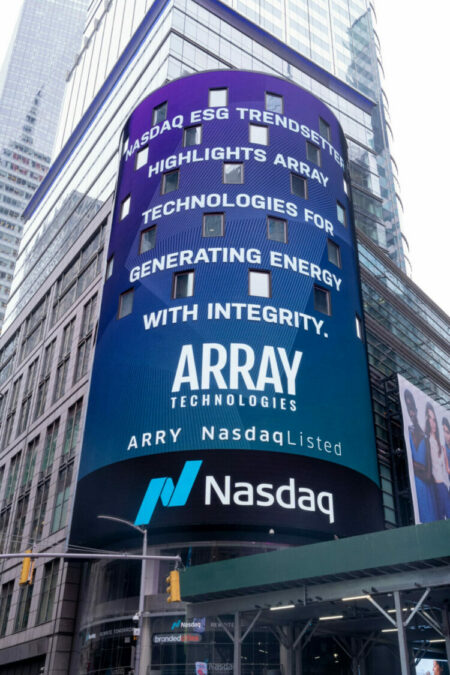
When Environmental, Social and Governance (ESG) emerged as an investing framework, it was misunderstood by some as simply a fleeting trend, but it is here to stay. For many publicly-traded companies, including ARRAY Technologies, it provides transparency for financial stakeholders – ranging from shareholders and customers to banks and insurance companies – to assess risks and potential rewards.
Our ESG reporting shows how we, as a renewable energy company, walk the talk on environmental responsibility when it comes to how we source materials and manufacture our products, which literally underpin utility-scale solar arrays. ESG reporting also holds us accountable to investing in our greatest asset: our employees.
We hope the current anti-ESG backlash fades as more people come to understand what our stakeholders – customers, investors and employees – already know: applying the fundamentals of investment analytics can provide a clearer assessment of value.
Whether or not ESG data is required by any regulatory framework, ARRAY will continue to provide ESG reports. They offer visibility into our business so that our stakeholders fully understand how we allocate capital to help solve the climate crisis with solar innovations. Likewise, ESG reporting commits us to diverse talent which allows us to optimally operate in each of our global markets with deep knowledge and various viewpoints.
To be sure, some ESG metrics may need refinement, as illustrated by debates surrounding Scope 3 emissions measurement accuracy, for example. ESG benchmarking and raters will continually improve.
Higher Calling or Standard Operating Procedure? ESG is Both
For ARRAY, ESG is naturally integrated with our core competencies and best practices. We know a company can perform well in business with ESG. We proudly live it every day.
As the focus on ESG intensifies, Nasdaq’s ESG Trendsetters series looks to highlight the top ESG professionals and teams around the world to discover how they are incorporating ESG factors into their corporate strategy, achieving meaningful impacts, and communicating with their stakeholders.
Our leadership recently met with Nasdaq to share our viewpoint for why ESG matters and how it’s integrated into our business and culture.
It’s no accident our ESG is led by our Chief Commercial Officer, Erica Brinker. Our ESG objectives are intractably linked with our commercial goals. Improving the sustainability of our products and supply chains helps our customers and revenues. Our entire business strategy is aimed at climate action and facilitating the global energy transition.
Governance is the driver to ensure the social and environmental goals can be accomplished. Our board’s Nominating, Governance and Social Committee includes four members of the board, including Chairman Brad Forth. The duties and responsibilities of all board members, including CEO Kevin Hostetler, upholds the promotion of long-term sustainable growth, which considers the social and environmental goals of the company.
Our ESG Journey
ARRAY’s 2021 ESG report included our first materiality assessment as we engaged stakeholders to help guide our ESG priorities. The report included 2025 goals with the following highlighted commitments for:
- Environment:
- Deliver components to support an additional 90,000 MW of solar power
- Reduce direct emissions intensity 30% from baseline year 2021
- Source 50% of direct energy consumption from renewable energy sources
- Social:
- Increase total workforce representation of women by 10% from baseline year 2021
- Increase non-executive management racial and ethnic minority representation by 10% from baseline year 2021
- Increase board representation of women 22% from baseline year 2021
- Governance
- Fulfilling the Nasdaq’s Board Diversity Rule
- Continuously evolving and adapting our Cybersecurity Framework’s security architecture, resiliency, response and recovery processes to meet persistent and growing threats.
- Updated Conflict Minerals policy to ensure our suppliers adhere to our high ethical standards and keep our supply chain
- Commitment to expanding GHGs inventory beyond Scope 1 and 2 emissions to incorporate Scope 2 supply-chain emissions
ARRAY aims to increasingly provide sustainability benefits for our products. For example, we have an agreement with Nucor to buy torque tubes and rolled steel produced with recycled steel. These materials are used by ARRAY to produce clamps, foundations and brackets, and other tracker components. Similarly, in 2021, our use of recycled aluminum at our Albuquerque increased by 11.8% to 3.5 million pounds.
Our 2022 ESG report to be published in Q2 will show further progress. ESG goals are not set arbitrarily. We reference the metrics of the Global Reporting Initiative and Sustainability Accounting Standards Board for stakeholders to clearly recognize our contributions within the broader ecosystem of ESG. These also serve as baseline metrics to identify growth opportunities and achieve results against objectives.
Customers rightfully want assurances our products are manufactured and distributed with the most environmentally preferable means possible. Investors want to see how we are increasing revenues while providing crucial components for renewable energy expansion. Demonstrating these commitments is also key in attracting and retaining talent. ESG benchmarks give everyone clarity on what we are doing and where we are going as a business.
As a renewable energy company, we believe we are held to a higher standard for ESG. What started as an investment management framework for risk assessments has evolved into an integral structure for business growth and integrity. ARRAY is proud to be a company rooted in and expanding with ESG.
The post ESG Metrics & Renewable Energy Companies: A Match Made in Sustainability appeared first on ARRAY Technologies.
]]>The post 3 Questions Investors Have About ESG Answered appeared first on ARRAY Technologies.
]]>ESG initiatives are based on values from within the company. These companies act conscientiously to improve the environment, their employees’ lives, and how they run their organizations.
Consumers and investors worldwide are paying more attention to ESG factors when making investment decisions. A 2022 Capital Group study revealed that approximately 89% of investors integrated ESG issues into their investment approach. Even oil and gas companies are investing in renewables. British Petroleum’s ownership stake in Lightsource, a solar and wind developer, is but one of many signs that the energy transition is happening.
So, here are some of the common ESG questions investors ask:
- How can I trust that a company follows ESG practices if there’s no universal standard and it’s all self-reported?
- ‘Positive change’ in governance and hiring can be subjective, so how can an investor evaluate positive change?
- Is investing in ESG companies risky because the funds won’t be in diverse funds/portfolios?
How can I trust that a company follows ESG practices if there’s no universal standard and it’s all self-reported?
First, consider what third-party reporting agencies say about the ESG company you’re interested in investing in. Start with the Global Reporting Initiative (GRI), the Sustainability Accounting Standards Board (SASB), and the Task Force on Climate-Related Financial Disclosures (TCFD) to triangulate the information they’ve each gathered because they all measure slightly different things related to ESG.
Second, look at the ESG initiatives and reporting the company offers on its website. Does the company operationalize around ESG and consistently report on it?
At ARRAY, we regularly provide a forum to answer ESG-related questions. Investors—and potential investors—can dial into quarterly earnings calls, which are open to the public. So, if investors have questions and can’t find the information they’re looking for, they can ask us directly.
‘Positive change’ in governance and hiring can be subjective, so how can an investor evaluate positive change?
First, think of “positive change” as “fair and equitable change.”
For example, increased hiring of diverse candidates and under-represented groups is just good business. The company not only recruits people from different backgrounds and with varied talents but also gains diversity of thought across the organization.
Another place where fair and equitable comes into play is the pay gap between men and women. Companies can address this head-on to drive retention and effective succession planning.
Diversity isn’t about checking a box—it requires a discipline that an organization might not be exercising. A company that starts with a diverse slate of candidates increases the odds of a diverse employee population. With a diverse candidate slate for every position, your company creates the opportunity to hire the most qualified person for the role.
Ultimately, shareholders want companies to hire and retain the best person for each position. Someone well matched for a position will get results and add value to the company. At ARRAY, we are ensuring that we start with diverse candidate slates from the time that we open a role, so that we have a better chance of hiring.
Will investing in ESG funds perform at similar rates as non-ESG funds?
Doing well while doing good is absolutely possible. When the NYU Stern Center for Sustainable Business and Rockefeller Asset Management examined the relationship between ESG and financial performance in more than 1,000 research papers published between 2015 and 2020, they found “a positive relationship between ESG and financial performance for 58% of the . . . studies.”
Being aware of the environment and suppliers, hiring diverse people, and having an independent board are all factors that make a company a more solid investment. They show that the organization is well run and mindful.
Investors increasingly want to invest in companies that report ESG data, so transparency is key. Companies that provide transparency come out ahead of companies whose ESG actions are unclear.
ESG should not pit profit against doing the right thing as a company. It is possible—and proven—that companies can do well in your financial portfolio while positively contributing to the environment around them, the communities they serve, and the employees who help make it all happen.
No investment is ever a guarantee. Investments must be thought of as long-term commitments, not as quick wins. Investing is about aligning with your values and investing long term in the planet.
How ARRAY is achieving its ESG goals
At ARRAY, we think of ESG as the way we run our business. We operationalize around the goals we put in place for 2025 and have working groups for each goal. We’re not working simply to get better scores or to put out a report—we want to be better as a company.
We list our policies on our website, and all our suppliers sign a code of conduct that speaks to antislavery, anti-bribery, and anti-child labor. We align ourselves with like-minded suppliers that are committed to making the same changes we do.
Many people choose to work at ARRAY because they want to be in the renewable space, and ESG and renewables go hand-in-hand. This purpose-driven culture attracts employees who not only want to do great work, but want to change the world while doing it.
Between our 2021 diversity baseline and 2025, we want to increase female representation in our workforce by 10%, racial and ethnic minority representation in our nonexecutive management by 10%, and female representation on our board by 22%. Impressively, we have already reached our board diversity goals by adding another woman, Tracy Jokinen, to our board of directors.
Perhaps the most rewarding and the most challenging is that the change we are driving through ESG requires a cross-functional team that works towards shared goals. When we published our first full-year 2020 report, we all rejoiced because everyone was so invested. It has been having this shared vision and a culture of continuous improvement that continue to drive us forward, getting better each year.
As a newly public company, it felt good to get an ESG report out within a year (and some change) of going public, but it was an incredibly heavy lift. It helped us grow exponentially as a company, and it was incredible for everyone to rally behind and celebrate it. Now that we are working on our third one, there is a sense of confidence around what we are tackling, but also a willingness to bring forward new ideas to drive progress.
As a company that is deeply engrained in the energy transition and renewable energy, we continue to look to the future, despite the many challenges ahead. At ARRAY Technologies, it is in our DNA to generate energy with integrity for a sustainable world.
Read more on our ARRAY Technologies investors relations page.
SIGN UP TO BE NOTIFIED WHEN OUR 2022 ESG REPORT IS AVAILABLE
The post 3 Questions Investors Have About ESG Answered appeared first on ARRAY Technologies.
]]>The post ARRAY in the News: 2023 Starts off Strong with Recognitions & Positive Financial Reporting appeared first on ARRAY Technologies.
]]>
ARRAY Alongside Primergy Solar Announced as Finalists for The Cleanie Awards 2022 Project of the Year—People’s Choice for Gemini Project
Focused on honoring innovators, accelerators, and disruptors who are creating market-moving climate solutions, The Cleanie Awards is the only cleantech industry awards program. The Project of the Year is awarded to projects that add tremendous community value.
The Gemini project is set to be the largest operational solar + storage project in the United States and one of the largest in the world when it is completed in 2023. ARRAY is proud to be supplying nearly 1GW of DuraTrack® single-axis solar trackers for the Gemini project led by Primergy, a company focused on investing in responsibly-sited solar and energy storage projects and has enlisted a consortium of solar industry leaders to build and maintain the project.
Voting is open until February 10, 2023, and at the time of posting, ARRAY and Primergy are in second place with a combined 44,562 votes.
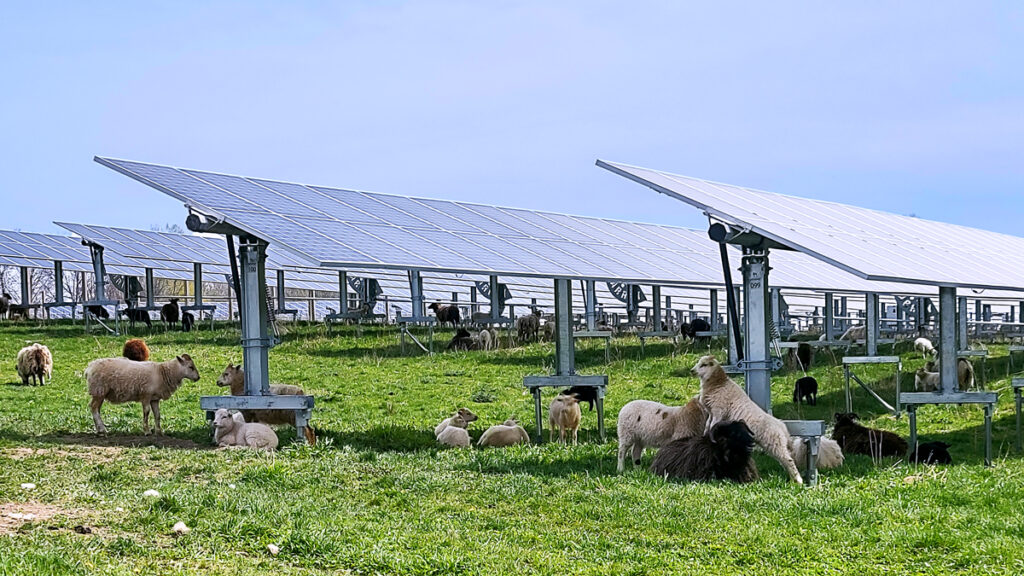
Photo credit: Highland Grazing, a United Agrivoltaics farm partner.
ARRAY Named One of America’s Most Responsible Companies 2023
Corporate responsibility isn’t just a buzzword here at ARRAY—it’s a cornerstone of our company and what helps make us a trusted, reliable choice for solar trackers and solar technology.
Newsweek partnered with Statista on its fourth annual list of America’s Most Responsible Companies, which honors organizations—including ARRAY—that strive for true excellence in terms of their treatment of customers and employees as well as the environment around them. This comprehensive ranking is an effort to recognize companies with a genuine commitment towards aligning business practices with ethical values and encourage more corporations to prioritize corporate social responsibility.

Yahoo!finance Includes ARRAY as Clean Energy Stock to Watch
In a recent article published on Yahoo!finance, an analyst said they “love” ARRY stock. The article highlighted five clean energy stocks they say play to the themes Morgan Stanley believes will impact clean technology in 2023, including:
- Focus on profitable growth and path to profitability,
- IRA benefits materializing later than expected,
- Supply chain easing in battery storage, driving strong growth and improved pricing,
- Inflationary utility bills and deflationary distributed generation, and
- Project announcements in green hydrogen.

Solar Power World Interviews Erica Brinker on Upgrades to Single-axis Trackers
Our Chief Commercial Officer and Head of Environmental, Social & Governance (ESG), Erica Brinker, recently sat down with Solar Power World’s Billy Ludt to discuss single-axis solar trackers and how they’re changing. In the article, Erica shares insights into why we developed our latest product, the ARRAY OmniTrack , and says, “Some of the very progressive developers globally, they don’t want to disrupt the topography, they don’t want to change the environment.”

Nasdaq Shares That The Zacks Analyst Blog Highlighted ARRAY
Recently Nasdaq shared a press release from Zacks, a leading investment research firm focusing on stock research, analysis and recommendations. In this release, an analyst includes ARRAY Technologies as of one of four solar stocks seeing “explosive growth.” The analyst goes on to share that due to governments attempting to speed up the switch to renewables, there’s huge demand for solar panels and related components—giving ARRAY a “Growth Score of A.”
At ARRAY, we’re always striving to be at the forefront of clean energy technology and innovation. We’re proud to see our efforts being recognized by some of the most respected names in solar power and finance, and we’ll continue doing everything we can to push the boundaries of what’s possible in renewable energy.
If you want to stay up to date on all things ARRAY, be sure to check out our press releases and blog and follow us on Twitter and LinkedIn. Thanks for supporting our mission of generating energy with integrity for a sustainable world!
The post ARRAY in the News: 2023 Starts off Strong with Recognitions & Positive Financial Reporting appeared first on ARRAY Technologies.
]]>The post Arizona Business Leaders Rally Behind the Build Back Better Act appeared first on ARRAY Technologies.
]]>Click here to read about the Arizona Technology Council press conference, view the clip below to watch the live event, or scroll down to read Erica Brinker’s remarks:
Remarks from Erica Brinker:
My name is Erica Brinker and I am the Chief Marketing Officer and Head of ESG at ARRAY Technologies. We are not only excited to represent utility-scale solar, but also our growing presence in Arizona.
ARRAY Technologies is the world’s largest utility-scale solar tracker technology company. We were founded more than 30 years ago as a company focused on building hardware and software technology engineered to enhance utility-scale solar productivity. We have operations in 7 cities around the world and serve customers in 51 countries.
Just last year, we went public, listing on the NASDAQ and have continued building out our corporate presence in the greater Phoenix area, taking advantage of Arizona’s most abundant natural resource – sunshine.
Earlier this year, we announced the launch of the ARRAY Technology Research Center located in Tempe. At the Center we test the latest in solar tracking advancements. Our growth has been so explosive that we are even moving into larger offices to accommodate more employees AND to support the incredible demand by our customers.
While we are extremely proud to be part of the clean energy revolution, we also think this is just good business and an industry worth investing in. The state’s support for businesses and its communities is a major factor to why we have chosen to expand our presence here in the state.
ARRAY Technologies continues to invest in Arizona and that is one of the reasons I am so excited to discuss what the Build Back Better Act means to companies and employees like ours.
Today, more than 300 companies and more than 7,300 people already have jobs in the solar power industry in the state of Arizona.
If passed, the Build Back Better Act, will create incentives to encourage businesses to enter or support the solar industry, increasing the number of high paying and living wage jobs in Arizona.
We already have an idea of the impact that this legislation could have. Since a similar support was enacted in 2006, called the ITC, the U.S. solar industry has grown by more than 10,000% – creating hundreds of thousands of jobs, investing billions of dollars in the U.S. economy in the process.
The Build Back Better Act includes more than $500 billion in investments for clean energy and environmental justice – including over $300 billion to expand and extend clean energy tax incentives.
These tax incentives have the power to unleash the clean energy economy utilizing a proven policy to ensure that America’s solar development continues to shine.
From our point of view, a vibrant solar industry is a bloodline for emerging clean energy sources including new technologies like battery storage.
The policies in the Build Back Better Act provide a strong signal to the world that the United States intends to be a leader when it comes to diversifying our energy sources and supporting clean energy. And Arizona is perfectly poised to capitalize on investments in the solar industry.
Thank you so much for your time today and I look forward to continuing the conversation about how we can work together to support the clean energy industry and, in turn, create more economic opportunity in Arizona. We don’t see the Build Back Better Act as a political matter. It’s just good business. Let’s work together to do well while also doing good.
The post Arizona Business Leaders Rally Behind the Build Back Better Act appeared first on ARRAY Technologies.
]]>The post America’s Solar Energy Agenda for 2050: Our Wish List to Make It Reality appeared first on ARRAY Technologies.
]]>The Biden administration recently announced a goal to produce 45% of US power from solar sources by 2050. To give some perspective, currently, solar power is under 4% of the US power grid but has accelerated at record rates over the past decade.
A blueprint to ramp up and meet these ambitious goals was outlined by the Department of Energy (DOE), projecting that solar power installation would have to be doubled over the next four years, then doubled again by 2030. Put another way, that means installing 30 gigawatts per year of solar capacity between now and 2025, and another 60 GW a year between 2025 and 2030.
That may seem daunting, but the utility-scale solar industry continues to grow at a breakneck pace. In order to reach these ambitious goals, we need to do something much differently than what got us to this point.
Ambitious Energy Goals – Can It Be Done?
After absorbing the DOE Solar Futures study, we do think that solar could ultimately make up 45% of total power generation in the US by 2050. With one massive caveat—you can’t get there without utility-scale solar. This conclusion is also supported throughout the DOE’s report. In other words, rooftop solar alone will not be enough.
This isn’t meant to dimmish the importance of rooftop solar—we support all the many ways solar can power the world with clean energy. But in order to make the massive shift to clean energy and move to a more carbon-neutral scenario, utility-scale solar deployments will be a necessity. And the price of solar has dropped 70% over the last 10 years, making it an ever-attractive and efficient way to deploy clean energy. A government-backed solar proclamation isn’t enough to make it a reality.
There will be lots of challenges, and it will require Herculean efforts like federal investment and major policy change. Unfortunately, money and policy will not be enough. Increasing utility-scale solar capacity will require incredible coordination with utilities, private and public investors, regulators, and more.
Even with all of these challenges, the possibilities of inexpensive, clean energy and ultimately a chance to substantially reduce carbon emissions by 2050 is real—and a future we are excited about. As we look at what is possible for utility-scale solar, there are essential actions that must be taken to clear the way for the short and long-term challenges that lie ahead.
The Biden’s administration’s announcement was a headline we were excited to read, but one that must be coupled with complementary action to drive change. Here are our six wishes to make the 2050 solar goals a reality:
- Creation of a stable regulatory and incentive environment so that the industry can make long term commitments to funding and capital
- Enhancement to the aging power grid so that there are fewer disruptions and consistent power delivered to homes and businesses across the US
- Streamlined permitting for solar so new sites can be identified and deployed faster
- Investment in battery storage technologies which will help to smooth the output of power
- Develop productive trading relationships with international module manufacturers so there is diversity in the supply chain
- Deployment of tax credits. Reuters reported 700+ companies requested long-term extensions of a solar investment tax credit in recent letters to Congress — this extension would “ease project financing challenges” and make the feat ahead of us more feasible.
The Solar Vision for 2050 is an American Story
At ARRAY, we take pride in knowing that the growth of solar means an increase in American jobs. The growth of a clean energy economy will create tens of thousands of jobs for Americans. In 2020 alone, more than 230,000 Americans worked in solar at more than 10,000 companies in every U.S. state. In 2020, the solar industry generated more than $25 billion of private investment in the American economy.
Solar is growing and continuing to put up the big numbers! And ARRAY is a U.S.-based company with U.S. manufacturing capabilities and a significant U.S. supply base. We are excited for the possibilities of how the clean energy economy will change the face of the nation’s carbon footprint and how it will transform the opportunities for American workers.
With a 30-plus year history of developing the world’s most innovative solar hardware and software, we’ve learned that solar is not tied to the outcome of an election or the passage of any one piece of legislation. Solar technology is no longer a fledgling experiment. It has developed into a sector that is beating out other modes of electricity generation and is getting better every day.
Today, we know that the speed to bring power generation online is faster with solar, when compared with wind, natural gas and nuclear. And when considering the consistency in energy delivery and steadiness of output, utility-scale solar comes out on top too.
The Ending Is Just the Beginning
We need an end to the idea that solar is a fad or some partisan point of debate. Utility-scale solar is an economic driver, a carbon neutralizer, a job creator and an electric power producer like no other. Solar provides a way to significantly impact climate change in a way that is financially beneficial to utilities, economically viable and safe for users and environmentally friendly for the planet.
While there are many challenges that lie ahead for the adoption and execution of solar’s future, we remain hopeful. If you are looking for us, we will be over here following the sun…and getting excited about turning vision into reality.
Check out more of our take on the Biden 2050 solar energy plan in this clip from Cheddar News
The post America’s Solar Energy Agenda for 2050: Our Wish List to Make It Reality appeared first on ARRAY Technologies.
]]>The post Agrivoltaics (Practically Speaking) and Solar Tracking appeared first on ARRAY Technologies.
]]>Competition for land is becoming more intense. Pastoral landscapes are ideal for both solar production and plant farming, putting major solar projects in direct competition with plant and animal farmers who have historically owned and managed the land.
Exploring possibilities for allowing the same plot of land to host both PV solar structures and cultivated plant life can lead to positive outcomes, including:
- Creating or boosting local ecosystems
- Fueling the local job market in rural communities
- Helping to solve projected food shortages
- Supporting water conservation
- Supplementing and stabilizing farmers’ incomes
We’ll explore these in this post. We’ll also discuss exactly how solar project developers can use single-axis trackers for this mutually beneficial setup.
What are Agrivoltaics?
The concept of co-developing land for both PV solar production and food crops or other plants dates back to 1981. The first prototype was developed in Japan in 2004 and the term agrivoltaics was likely first published in 2011. A decade later, there are agrivoltaic projects of different scales all around the world.
Rather than using gravel or paving the ground beneath solar arrays, these dual projects have grasses, pollinator plants, or food crops below. PV modules work optimally in a sunny, cool environment. Plant life naturally holds and releases water vapor into the surrounding air, which cools it. This harmonious arrangement means modules perform better and the right plant life can grow better, partially shaded by these technological structures.
Different countries experiment with crop categories and their capacity to thrive beneath solar arrays. Not all plants do well beneath the modules, but some species actually thrive in partial shade, and others can be planted beneath strategically spaced solar trackers.
At sites throughout the U.S., lettuce and other leafy greens, peppers, peas, and many other crops are being grown. One study showed even typically shade-intolerant corn grows well beneath PV solar trackers and modules. In France, experiments growing agrivoltaic vineyard grapes not only proved successful, but required less watering, as the grapes were able to hold onto moisture in the shade. Japanese agrivoltaic fields grow shade-hungry ginseng and coriander.
Projects of various sizes and compositions span across Europe, Asia, the Americas, and Australia. Organizations in China and Australia are even using agrivoltaic practices to counteract drought and desertification.
How Agrivoltaics Work Out All Around
Rather than threaten a farmer’s livelihood, PV solar generation can offer additional income to farmers who lease their land and/or sell the energy produced. This can smooth out fluctuations in income due to weather unpredictability, to which farmers are typically subjected.
One study modeled an economic value boost of 30% for farmlands utilizing agrivoltaic crops over conventional crops. Another showed it could increase land use efficiency by 60 to 70%.
The shade provided by solar modules can actually establish a new microclimate that supports and sustains the local ecosystem through pollination and water retention.
Grasses, wildflowers, and other crops that don’t produce food directly offer a haven for pollinators such as butterflies, honeybees, and birds. Pollinators are responsible for an estimated 35% of the world’s food supply and are in danger of decline or extinction as habitats become scarcer, among other challenges.
Shading from solar modules supports water retention in soil and reduces water usage through less need for irrigation. A study by NREL showed water efficiency increases of over 150% and even double or triple fruit production through agrivoltaic practices.
How Trackers and Solar Developers Play a Role
Single-axis solar tracking systems can not only optimize the amount of sunlight modules absorb throughout the day, but their movement can also allow more sunlight through to the plants below (compared to fixed-tilt systems). They can also shield crops during hailstorms.
Of course, not every site can host an agricultural Garden of Eden beneath its panels, but doing so, when possible, can help offset the (already comparatively minimal) ecological impact of solar PV sites where cement or gravel are used.
Solar developers and investors can select “brownfields,” vacant or abandoned developed plots of land, for projects. Not only does this support ecosystems in previously dry, lifeless places, it can also stimulate the local job economy through employing local workers.
ARRAY Technologies and Agrivoltaics
The architecture of DuraTrackⓇ Hz3 makes it a more friendly option to the plant life below with a minimal amount of shading and a flexible ground coverage ratio. In addition to this, SmarTrackTM eliminates backtracking and thus reduces shadowing against modules. This makes it a good option for projects to use a wider variety of plant species while also ensuring that energy production is still consistently optimized.
DuraTrack’s highly adaptable frame makes it ideal across different types of terrain. Depending on the configuration of the land hosting the structure, it can also be installed at different heights, which plays a role in how much light hits the ground as well.
RP Construction Services Inc. (RPCS) recently installed DuraTrack trackers in the first dual-use project in Monson, Massachusetts. The site, called Million Little Sunbeams, was designed with 20-foot row spacing at a height of 10 feet to allow sunlight to reach the crops below and for tractor access.
Agrivoltaics Help Solve Multiple Problems at Once
Combining both smart engineering and smart ecological practices can further align the technology used to create cleaner forms of energy with agriculture. From a practical standpoint, it helps chip away at some of the world’s biggest problems and mitigates the competitive trajectory of solar farm vs. food farm.
From a philosophical perspective, these solutions fuel life in more than one way, supporting major systems involved in producing both the food we need for life and the energy we need to live it, coexisting beautifully. For a more in-depth look at the possibilities of agrivoltaics and ARRAY’s part in them, download this white paper: Solar Power + Agriculture: The Practices and Synergies of Agrivoltaics from our partner RPCS.
The post Agrivoltaics (Practically Speaking) and Solar Tracking appeared first on ARRAY Technologies.
]]>The post Part 2: Historic and Current Market Risk Assessment for Utility-Scale PV Solar Lenders and Insurers appeared first on ARRAY Technologies.
]]>One significant change is utility-scale solar power plants growing in size. 1 MW was about average for a project in North America at that time. Now average plant sizes are around 100 MW or more, some even approaching 1 GW.
This incline in project size and fast-tracked component and software innovation make risk assessment both more complicated and more valuable.
Historic stumbling blocks and current improvements
Historically, financial stakeholders in utility-scale PV have felt largely in the dark in terms of identifying and allocating risk. A decade ago, lenders and insurers reported a lack of solid understanding about the solar market themselves and doubted in developer ability to fully address their concerns.
More independent research, testing, and communication have unblocked channels to more accurate risk assessments.
Lack of consistent data on solar equipment durability
Rigorous testing of solar hardware has often been lacking in the industry. This is in part because of the disparity between controlled lab results and real-world testing.
The lack of long-term test data on real-world PV viability has also made insuring these assets more challenging. This lack of information skews the perception of solar components and installation as higher risk.
NREL released a landmark report on the challenges and solutions for insuring PV in 2010. The paper addressed an increase in financial losses in the insurance industry since 1960. Insured losses grew from almost nothing to $50 billion in 2005, and uninsured losses increased from $5 billion in 1950 to more than 70 billion in 2005.
Currently, news of continuous hurricane strikes, as well as longer and more dangerous fire seasons spreading wider across the western United States and Australia, is rampant. NOAA predicts an increase in category 4 or 5 hurricanes and more forceful winds to only increase due to climate change.
There is still insufficient information comparing the reliability of equipment from different suppliers over the 30+ year lifecycle of a modern PV solar power plant, but recent studies have shown that operations and maintenance costs can significantly effect profitability over the lifecycle of a PV solar power plant. Given this reality, lenders and insurers typically have simple approved vendor lists with all equipment on those lists considered equal in terms of reliability. We have seen numerous examples where unreliable, failure-prone equipment is on these vendor lists. This happens because there is not enough real-world data available on component failure rates.
Industry trade groups have, however, developed standard compliance practices. Model contracts, installation and O&M best practices, and the US Department of Energy’s Orange Button data standard can be used as benchmarks to navigate risk. Third-party testing is also more common and necessary to avoid siloed/bad data.
Since PV systems are subject to extreme weather, environmental tests are crucial. This has never been truer as climate change intensifies weather around the world. At ARRAY, we put our equipment to the test using both modeling and real-world scenarios utilizing assessment by 3rd party engineers to make sure we can back up durability claims.
Lack of performance data
Insuring PV sites has been a difficult task for underwriters who don’t have extensive knowledge about solar performance expectations. Since the solar industry is relatively young, data on insurance claims have also been thin.
Here again, over the past decade, industry agreement on performance and component benchmarking have created data sets for investors and insurers to evaluate risk better.
Investors are now using industry comps (traditionally used by project developers) to compare portfolio operating health and payment performance.
Component benchmarking helps identify any latent portfolio risks by reviewing sub-par equipment performance or performance trends across regions.
Industry-specific insurers
Having an insurance broker who knows the solar industry and business particulars can make the difference between paying inflated insurance premiums and getting more precise coverage at a good price.
There are even solar-specific packages covering the most common risk exposures or individual policies for certain issues, depending on the project.
Lack of standard certification
The best components installed incorrectly can be financially damaging or even dangerous. Financiers have been hesitant to back projects in some cases because of the inconsistent standards in contractors and subcontractors who build the equipment on site.
Insurers have also traditionally cited loose certification guidelines for installers as a potential weakness.
Although there are still some loose optics to certification standards, industry groups are formulating more consistency in what should be included. Working with a well–vetted EPC company with a good track record is the best way to ensure quality work.
Investors as risk managers
Investors must act as risk managers in order to satisfy the business and compliance requirements of senior business leaders, credit committees, internal and external auditors, and regulators. Doing so reduces the risk of technological and credit-related risk factors and increases project cash flow.
Trust, but verify the information coming in from asset managers. This is not to say that asset managers don’t have the knowledge or would purposefully mislead—simply that proactively working to resolve any oversights could diminish returns shortfalls.
Perhaps the most challenging part of current market assessment is the ability to calibrate the complexity of risk analysis with appropriate management. This adjustment is based on the size and type of each individual project.
While a more robust market means more standardization and better benchmarks, cookie-cutter approaches don’t apply well to solar projects. An individualized and fresh eye should be brought to every new opportunity.
Bigger projects, essential to get it right
The larger the project scale, the more incremental differences in power production over time add up to either make or break investor returns.
One of the critical attributes in mitigating the risk of reduced performance (and cash flow) is excellent design standards. Nothing can substitute for thoughtful design.
We’ll talk more about how to select and use equipment that best improves system performance in part three, “Why PV Trackers Are a Critical Component of a Risk Profile for Utility-Scale PV Solar Lenders and Insurers.”
The post Part 2: Historic and Current Market Risk Assessment for Utility-Scale PV Solar Lenders and Insurers appeared first on ARRAY Technologies.
]]>The post Flocking to a Utility-Scale PV O&M Solution appeared first on ARRAY Technologies.
]]>However, there’s been a unique innovation in PV plant operation – though it comes from a simple and decidedly old-school source.
Sheep’s New Role in Lowering PV Plant Operations and Maintenance Costs
You read that correctly. Sheep are now being used for landscaping duty on PV plant sites, merging the worlds of agriculture and solar power in a mutually beneficial way.
According to the National Renewable Energy Lab, utility-scale solar arrays could occupy three million acres of American land by 2030. This expansion is causing tension between the solar production industry and the livestock and farming industries that rely on acreage to be productive.
Instead of restricting the use of useful grazing land solely for solar energy production, the hybrid solution of solar grazing, as it’s known, to effectively landscape and manage array vegetation is an increasingly popular and cost-effective solution.
Why Solar Grazing?
In 2019, nearly 20 states were employing solar grazing to some degree, with that number expected to grow even further throughout 2020 – and for good reason.
In addition to allowing for greater access to key land for livestock farmers, solar grazing also carries many benefits for solar plant owners and operators.
According to a 2018 Atkinson Center report from Cornell University researchers, labor hours typically spent mechanically managing vegetation and utilizing pesticides were reduced with the use of solar grazing. In fact, 2.5 times fewer hours were needed.
The use of solar grazing also promotes environmental responsibility and reaffirms a plant’s commitment to sustainability. It could also come with incentives, particularly as it grows in popularity – Massachusetts already offers solar grazing incentives, and other states could follow suit shortly.
Sheep are the perfect animal for the job, as well. They’re small enough to fit under and around arrays, but don’t wreak the havoc that goats and other animals can cause, typically only grazing on what they’re supposed to – the vegetation.
There are certainly major considerations, particularly on the part of the flock’s owner, including rotating sheep to avoid overgrazing, avoiding brownfield sites that could harm animals, and more. But the benefits of practicing solar grazing outweigh this risk with careful forethought and planning.
Efficient Plant Design and Efficient O&M
For utility-scale PV plants, good design means taking into account every innovative strategy to reduce O&M costs from the onset of the project.
Solar grazing can be part of a holistic effort to reduce those costs, particularly when supplemented by other project decisions.
Choices made in design and component selection affect long-term O&M as well.
Choosing a tracker with a centralized architecture can significantly reduce long-term O&M costs associated with maintenance, as shorter-lifespan components like batteries, electromechanical devices, and more in decentralized tracker designs can drive up maintenance costs, especially after a typical 5-year warranty expires. So can the sheer number of components in decentralized solutions – the more parts, the more potential for failure and downtime.
By focusing on an ideal of “zero maintenance” and placing uptime, less corrective maintenance, and creative solutions like solar grazing at the top of a plant’s priority list, operations and maintenance costs can be greatly reduced.
ARRAY Technologies has been an innovator in the solar power industry, providing solutions that stress long term value and optimize performance. ARRAY produces robust solar trackers, but recognizes innovative O&M solutions, like adding sheep to the equation, are part of a flexible, adaptive strategy that can boost overall efficiency and reduce costs during the 25-30 year lifespan of a utility-scale PV solar plant.
Solar Grazing in Action
It’s a two-way street, as well – while providing cost-cutting efficiency for plant operators, solar grazing can provide an additional revenue stream for landowners who rent land to plants as opposed to moving flocks onto land already used for solar power. One thing is certain – the use of sheep for solar grazing is pushing into practice incentives and pilot programs around the globe as the industry looks to implement the most efficient O&M best practices.
ARRAY’s DuraTrack® single-axis solar trackers have already begun taking part, being leveraged on a farm in Australia where Dubbo sheep grazer Tom Warren has leased some of his land to Neoen for a 20-megawatt solar farm. This strategy had diversified Warren’s income stream – in addition to wool production, he’s also collecting rent for the plant’s portion of the land.
At ARRAY, we’re all about maximizing production, and our DuraTrack® HZ v3 tracker delivers unprecedented value, reliability, durability, and quality.
We hope to see our best-in-class solutions popping up all around the world in solar grazing efforts as part of the industry’s push toward adopting the practice on a much larger scale.
How to Get Started?
The American Solar Grazing Association (ASGA) is actively working to inform plant operators and farmers about the use of solar grazing and to promote the practice on solar installations.
Further, the ASGA facilitates research, best practices and more while also offering memberships and a tool to connect farmers with solar projects interested in employing solar grazing.
To learn more, contact the ASGA or reach out to ARRAY Technologies to find out how we can assist in improving your utility-scale solar plant operations and management practices.
The post Flocking to a Utility-Scale PV O&M Solution appeared first on ARRAY Technologies.
]]>The post Everything’s Bigger in Texas, Including the Power Challenges appeared first on ARRAY Technologies.
]]>The massive Electric Reliability Council of Texas (ERCOT) grid distributes energy to the biggest state in the continental U.S. Through large-scale utility projects and tracker design options that meet individual site needs, ARRAY has helped solve some Texas-sized problems.
Step back and think about the fact that ERCOT holds its place among just two other power grids in the entire 48 lower states. The Lone Star State maintains its own grid to steer clear of federal oversight. It’s clear that Texas still has a little Wild West running through it.
However, the unique situation of ERCOT running an independent grid offers both advantages and disadvantages in terms of energy production and distribution. Solar is playing a part in smoothing out the disadvantages.
The State of Texas Utility Power
In 2019, Texas saw a 13% increase in energy rates over the 2018 average while the rest of the country saw a decrease. It was a brutally hot summer that sent energy demands through the roof and tested the limits of the independent grid.
ERCOT delivers power to a large portion of Texas and, on occasion in the past, to other nearby grids. Through its history, the indie grid has sent power out to Oklahoma and imported power from Mexico during looming or active blackouts. This has led to messy legal issues and insecurity.
The good news is that things are changing. 2020 already looks better due to more renewables, including a significant increase in online solar.
Renewable Goals and LCOE
Despite being born of oil, Texas is now a state that’s embracing solar in the 2020s. Austin Energy and other utilities across the state have major goals for renewables. Austin is shooting for 65% renewables by 2027. Widescale solar is playing a major part in hitting those numbers.
At ARRAY, our focus is always on making more efficient systems and lowering the levelized cost of energy (LCOE) for project developers. Helping increase a project’s ROI means ARRAY helps create more clean solar energy in Texas and around the world.
Our thoughtfully designed trackers are populating one of the largest bifacial solar plants in the Americas (in Texas) along with many other design deployments to maximize sun capture in the Lone Star State. We have to say, it feels great to be part of the solution.
A fast-growing population and prosperous business environment challenges Texas’s power grid, and severe weather events like hail, tornadoes, and flooding make logistics and construction challenging. On the other hand, Texas has so much space and access to transmission lines that in many ways it is ideal for major solar sites. Getting those sites up and running quickly and making sure they are secure in extreme weather (including wind and hail) is where ARRAY trackers really make all the difference for successful utility-scale developers and site owners.
How does contributing over 2GW of solar trackers to some of the most significant solar projects on the ground in Texas feel? It generates some Texas-sized feelings of pride.
Travis Rose, Vice President of Sales–North America for ARRAY Technologies, is both a Texas resident as well as a graduate of the University of Texas.
The post Everything’s Bigger in Texas, Including the Power Challenges appeared first on ARRAY Technologies.
]]>