The post 3 Questions Investors Have About ESG Answered appeared first on ARRAY Technologies.
]]>ESG initiatives are based on values from within the company. These companies act conscientiously to improve the environment, their employees’ lives, and how they run their organizations.
Consumers and investors worldwide are paying more attention to ESG factors when making investment decisions. A 2022 Capital Group study revealed that approximately 89% of investors integrated ESG issues into their investment approach. Even oil and gas companies are investing in renewables. British Petroleum’s ownership stake in Lightsource, a solar and wind developer, is but one of many signs that the energy transition is happening.
So, here are some of the common ESG questions investors ask:
- How can I trust that a company follows ESG practices if there’s no universal standard and it’s all self-reported?
- ‘Positive change’ in governance and hiring can be subjective, so how can an investor evaluate positive change?
- Is investing in ESG companies risky because the funds won’t be in diverse funds/portfolios?
How can I trust that a company follows ESG practices if there’s no universal standard and it’s all self-reported?
First, consider what third-party reporting agencies say about the ESG company you’re interested in investing in. Start with the Global Reporting Initiative (GRI), the Sustainability Accounting Standards Board (SASB), and the Task Force on Climate-Related Financial Disclosures (TCFD) to triangulate the information they’ve each gathered because they all measure slightly different things related to ESG.
Second, look at the ESG initiatives and reporting the company offers on its website. Does the company operationalize around ESG and consistently report on it?
At ARRAY, we regularly provide a forum to answer ESG-related questions. Investors—and potential investors—can dial into quarterly earnings calls, which are open to the public. So, if investors have questions and can’t find the information they’re looking for, they can ask us directly.
‘Positive change’ in governance and hiring can be subjective, so how can an investor evaluate positive change?
First, think of “positive change” as “fair and equitable change.”
For example, increased hiring of diverse candidates and under-represented groups is just good business. The company not only recruits people from different backgrounds and with varied talents but also gains diversity of thought across the organization.
Another place where fair and equitable comes into play is the pay gap between men and women. Companies can address this head-on to drive retention and effective succession planning.
Diversity isn’t about checking a box—it requires a discipline that an organization might not be exercising. A company that starts with a diverse slate of candidates increases the odds of a diverse employee population. With a diverse candidate slate for every position, your company creates the opportunity to hire the most qualified person for the role.
Ultimately, shareholders want companies to hire and retain the best person for each position. Someone well matched for a position will get results and add value to the company. At ARRAY, we are ensuring that we start with diverse candidate slates from the time that we open a role, so that we have a better chance of hiring.
Will investing in ESG funds perform at similar rates as non-ESG funds?
Doing well while doing good is absolutely possible. When the NYU Stern Center for Sustainable Business and Rockefeller Asset Management examined the relationship between ESG and financial performance in more than 1,000 research papers published between 2015 and 2020, they found “a positive relationship between ESG and financial performance for 58% of the . . . studies.”
Being aware of the environment and suppliers, hiring diverse people, and having an independent board are all factors that make a company a more solid investment. They show that the organization is well run and mindful.
Investors increasingly want to invest in companies that report ESG data, so transparency is key. Companies that provide transparency come out ahead of companies whose ESG actions are unclear.
ESG should not pit profit against doing the right thing as a company. It is possible—and proven—that companies can do well in your financial portfolio while positively contributing to the environment around them, the communities they serve, and the employees who help make it all happen.
No investment is ever a guarantee. Investments must be thought of as long-term commitments, not as quick wins. Investing is about aligning with your values and investing long term in the planet.
How ARRAY is achieving its ESG goals
At ARRAY, we think of ESG as the way we run our business. We operationalize around the goals we put in place for 2025 and have working groups for each goal. We’re not working simply to get better scores or to put out a report—we want to be better as a company.
We list our policies on our website, and all our suppliers sign a code of conduct that speaks to antislavery, anti-bribery, and anti-child labor. We align ourselves with like-minded suppliers that are committed to making the same changes we do.
Many people choose to work at ARRAY because they want to be in the renewable space, and ESG and renewables go hand-in-hand. This purpose-driven culture attracts employees who not only want to do great work, but want to change the world while doing it.
Between our 2021 diversity baseline and 2025, we want to increase female representation in our workforce by 10%, racial and ethnic minority representation in our nonexecutive management by 10%, and female representation on our board by 22%. Impressively, we have already reached our board diversity goals by adding another woman, Tracy Jokinen, to our board of directors.
Perhaps the most rewarding and the most challenging is that the change we are driving through ESG requires a cross-functional team that works towards shared goals. When we published our first full-year 2020 report, we all rejoiced because everyone was so invested. It has been having this shared vision and a culture of continuous improvement that continue to drive us forward, getting better each year.
As a newly public company, it felt good to get an ESG report out within a year (and some change) of going public, but it was an incredibly heavy lift. It helped us grow exponentially as a company, and it was incredible for everyone to rally behind and celebrate it. Now that we are working on our third one, there is a sense of confidence around what we are tackling, but also a willingness to bring forward new ideas to drive progress.
As a company that is deeply engrained in the energy transition and renewable energy, we continue to look to the future, despite the many challenges ahead. At ARRAY Technologies, it is in our DNA to generate energy with integrity for a sustainable world.
Read more on our ARRAY Technologies investors relations page.
SIGN UP TO BE NOTIFIED WHEN OUR 2022 ESG REPORT IS AVAILABLE
The post 3 Questions Investors Have About ESG Answered appeared first on ARRAY Technologies.
]]>The post 3 Major Hurdles to Solar Energy Growth (and 3 Solutions) appeared first on ARRAY Technologies.
]]>
Obstacles to the growth of solar energy
There are three major hurdles:
- Grid interconnection delays
- Negative pricing
- Solar curtailments
What could cause delays in grid interconnections?
North America has two major—and three minor—power grids, or “interconnections.” Every new utility-scale solar site must request connection to these grids. At this point, they enter whatas’s known as the “generator interconnection queue.” This queue consists of four stages:
- The project developer initiates the interconnection request
- The necessary interconnection studies begin
- The utility and generation owner negotiate the interconnection agreement
- Commercial operation starts
Projects can spend years waiting in this queue, with some assessments finding 3.7 years to be the typical time required for generation projects to complete the interconnection request process and begin commercial operations.
What does negative pricing mean?
Negative pricing happens in the spot markets when demand for solar energy is low andor supply suddenly increases. It can force renewable power plants to give away electricity or even pay distributors to take it. If the price goes negative, developers cannot recoup the costs of building their solar projects and are therefore less inclined to build projects where negative pricing is a possibility.
For reference, spot markets are “a commodities market in which the commodity is sold for cash and is delivered to a specific location for a specific time period that occurs on the day of the sale or on the day after the sale.”
When are solar curtailments used?
Excess renewable energy supply can also lead to curtailment. This is when operators or utilities require reduced solar energy from generators as a way of reducing transmission congestion. Sometimes curtailment goes so far as to completely shut down generation from a project for a period of time, wasting the solar energy that could have been produced.
Negative pricing and solar curtailments occur worldwide. One recent example of curtailment happened in Spain. Curtailment caused by insufficient energy transmission—failure to move enough power from renewable generators to locations needing power—has also occurred frequently in Texas, a leader in wind and solar power installations.
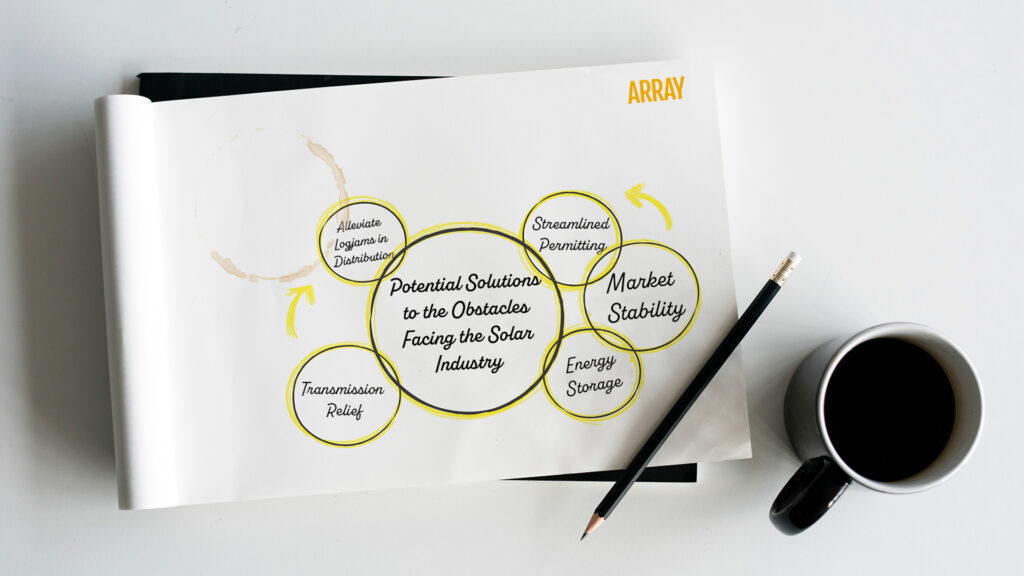
Potential solutions to the obstacles facing the solar industry
Long-term power purchase agreements between utilities and solar projects (PPAs) provide financial support to build out more renewable energy generation. However, while PPAs may bypass spot market mechanisms, the power generated might not always be able to flow across the grid. This is usually due to infrastructure issues.
So how do we solve these threats to solar power? As a global provider of solar trackers, we at ARRAY take a broader, long-term view of these issues. We see solar curtailment as a pressing but relatively temporary concern.
Three potential solutions are:
- Improving transmission and eliminating bottlenecks
- Advancing current energy storage and developing new energy storage technology
- Improving market stability
Transmission relief
Grid weaknesses threaten to stymie the growth of renewable power. Curtailment is a symptom of the need for improved transmission, which is on the horizon, but it takes time to build out the grid.
Grid operators, markets, and policymakers are responding to the demand for expanded transmission. For example, the Midwest Independent System Operator (MISO) recently approved 18 new transmission projects to support the shift to more renewables in the generation mix.
MISO’s grid spans all—or a portion of—15 U.S. states and the Canadian province of Manitoba. The first of the new transmission projects is expected to come online in 2028. Prior to these recently approved projects, the last major transmission project in the MISO region was approved more than 10 years ago.
Improved and expanded transmission will alleviate logjams in distribution, reducing the need for curtailment.
Energy storage
Expanding the use of storage—whether batteries are deployed at the site of generation or distributed across the grid—can provide an outlet when there is excess power. If more power is generated than is immediately needed, it can be saved for later when demand is high. This avoids wasting renewable energy and provides the opportunity to sell the power when it is needed rather than sell it below its value when it’s not needed.
Thinking beyond the energy storage options we already have in place could also be a major piece of the energy mix puzzle. There are solutions that simply haven’t been uncovered yet.
Market stability
Solar power expansion is a necessity for economic development and climate action. We’re hopeful that the growing recognition of local renewable energy as being vital to national energy security will spur further interest in clean energy manufacturing and technology innovation.
Our wish list for enabling more solar power covers many of the things we see as hugely important in achieving more market stability:
- A stable and incentivizing regulatory environment that will provide certainty for the long-term investments needed to expand renewable energy, including sustained tax credits
- Infrastructure enhancements to speed access to grid interconnection and to meet demand
- Streamlined permitting for solar power projects
- Breakthroughs in battery technology to widen deployment of energy storage
- Improved global trade transparency and reliability
Better market stability will address all three of the hurdles discussed above. Interconnection delays will grow shorter with streamlined permitting, and negative pricing and curtailments will be alleviated by a more stable regulatory environment, infrastructure enhancements, and better storage.
What’s Next for the Renewable Energy Industry?
Solar power is crucial for industrialized and developing countries to ensure access to emissions-free, reliable electricity. Technological and engineering breakthroughs have lowered the costs of photovoltaics, but now economic shortfalls and logistical roadblocks threaten further progress.
Thankfully, a growing number of investors, regulators, and consumers are sounding the call for clean energy. The industry is ready to build on its success and win over even more energy consumers—the ultimate drivers of market forces.
In the meantime, we’re continuing to develop new ways to make solar tracking both simpler and more sophisticated. By focusing on making solar sites as functional and productive as possible, we’re doing our part to make our solar wish list come true.
The post 3 Major Hurdles to Solar Energy Growth (and 3 Solutions) appeared first on ARRAY Technologies.
]]>The post Two Solar Trends That Aren’t Going Away appeared first on ARRAY Technologies.
]]>- The importance of a solid, reliable supply chain, and
- The increased demand for solar energy—and utility-scale solar sites.
We are living in a pivotal time. The world continues to grapple with climate change and its impacts on the planet, and the growth of the clean energy industry has never been more critical.
These past few months, the ARRAY team and I had the pleasure of attending two of the renewable energy industry’s largest and most important industry conferences—RE+2022 in California, U.S. and All-Energy in Melbourne, Australia.
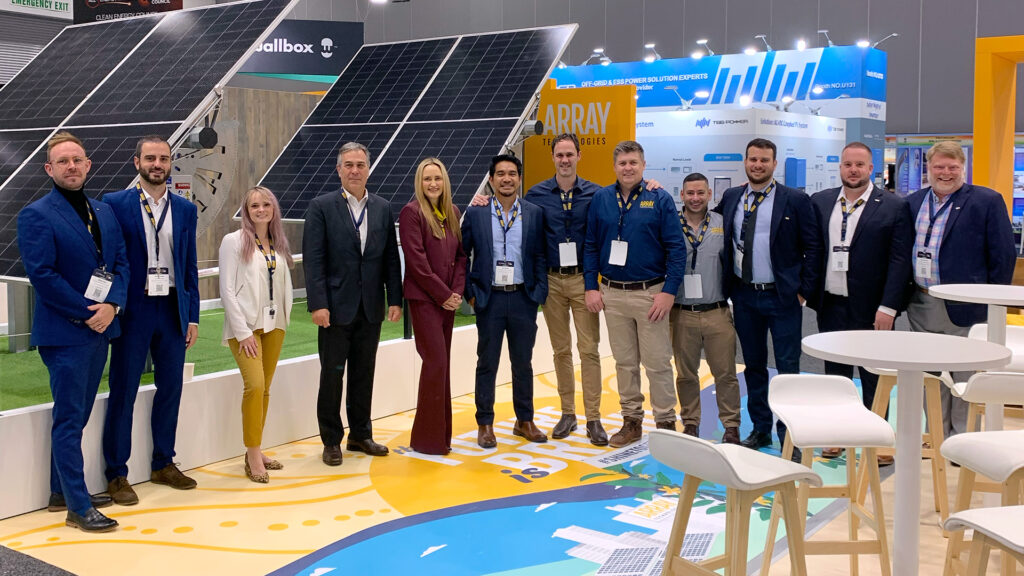
Erica Brinker (5th person in from the left), with the ARRAY team at All-Energy AU 2022.
It’s been three years since these conferences were last held in person, and there was a noticeable buzz at each as major players from the clean energy industry reunited.
Even though the shows were on two separate continents, both markets agreed that the future is bright for renewable energy, especially solar.
Building More Utility-Scale Solar Requires a Solid, Reliable Supply Chain
RE+ 2022 is North America’s largest and most comprehensive conference for the renewable energy industry. And the questions on all attendees’ minds seemed to be about needing more robust and regionally diversified supply chains to meet our industry’s continued growth.
Thankfully, ARRAY already has a long-standing and mature U.S. domestic supply chain with a strong record of execution including the ability to source up to 90% of our products domestically. So, we were able to use our well-established domestic content and partnerships to answer attendees’ questions with confidence as we navigate the unknown waters of the opportunity that the IRA bill brings to the industry.
Our longstanding domestic supply chain continues to be important to us as a U.S.-based manufacturer and now its even more important to our customers with the incentive that the IRA bill brings.
Not only do we strive to have the shortest and most reliable lead times in our industry, but ARRAY uses U.S. steel mills and partners with suppliers that source green steel from the U.S. Even so, we’re constantly improving on better ways to serve our clients and work with industry partners committed to clean energy solutions.
The RE+ conference brought together the industry’s top executives and innovative companies from around the world. We were grateful for the chance to share how ARRAY plays a significant role in building the clean energy future. At the show, we not only celebrated the huge public policy win of the IRA bill, but also introduced our newest utility scale offerings, the ARRAY OmniTrack as well as the ARRAY STI H250 trackers to the U.S. market.
The Future is Bright for Solar as Demand Continues to Grow
RE+ set a high bar ahead of All-Energy Australia, but it did not disappoint. The 2022 Australian event was the largest ever held, with a record number of attendees, more than 300 exhibitors, and more than 200 speakers at panels and presentations.
We had a lot of great discussions with clients and partners concerning local market conditions and the opportunities for 2023 and beyond.
ARRAY has been operating in Australia since 2017, with over 2 gigawatts of projects deployed in-country. We have offices in Sydney and employees throughout the region. We’re well-positioned down under to help Australia meet their solar energy goals by offering more of ARRAY’s products to the market.
The Australian government plans to generate 95% of energy from renewables by 2035. Given the distance of Australia from other major regions and wide-open geography, the country is ideally suited for solar, which could provide much-needed infrastructure support to the more remote areas. The country is also focused on developing domestic content requirements in some states. This has created an opportunity for ARRAY to boost its supply base in the country and be closer to where our customers’ projects are.
Learn more about the full suite of ARRAY Products.
Many clients and industry partners shared that there is growing international interest in “mega projects,” in part because Australia’s geographic location provides the ability to supply energy not only for itself but also to other APAC countries. One innovation that could help make these projects more feasible is automation.
For some local projects, there are still challenges to be managed. For example, delays in grid interconnection issues remain a sticking point for new solar projects, as in other global regions.
Whether it’s a collection of smaller projects, one large project, or grid delays, the ARRAY team looks forward to continuing conversations with strategic customers to help generate energy with integrity.
With its geographic location, natural resources, and innovative industry technologies like ARRAY’s solutions, Australia is ready to take its place as a global leader in the clean energy space. The future is as bright in Australia as in Southern California, and ARRAY is ready to do our part to advance the clean energy future for our customers and citizens worldwide.
All around the world, the growth of the solar industry can be seen, and the excitement is palpable. ARRAY Technologies is proud to be at the center of the energy transition all over the world. These are exciting times!
The post Two Solar Trends That Aren’t Going Away appeared first on ARRAY Technologies.
]]>The post How Robotics Can Help Global Renewable Energy Goals & Create Jobs appeared first on ARRAY Technologies.
]]>According to estimates, the solar sector will need to reach 400,000 jobs by 2030 and more than double by 2035 to meet climate goals set last year.
How can solar project developers meet higher demands while keeping projects on track? And how can the solar industry train thousands of skilled workers and get them up-to-speed and ready to work?
One answer is robotics. The role of robotics is more important than ever amid the workforce limitations in the solar industry. New technology will play a critical role in developing utility-scale solar projects to help meet energy goals in the U.S.
Deploying robotics technology enables the industry to achieve ambitious solar deployment goals because it makes solar construction more efficient while shortening operator training times. From shipping and packing methods and transportation to installation, robotics provides a way to shrink the labor and time needed to deploy utility-scale solar.
Solar & Robotics Technology and Process
Many companies are already looking to crack the robotics code in utility-scale solar. One company, Sarcos Technology and Robotics Corporation (Sarcos), uses technology that provides intelligent mobile manipulation systems for complex and often dangerous outdoor environments, making the role of robotic applications helpful in improving safety, productivity, and efficiency.
Sarcos’ robotics have been applied in the aviation, defense, energy, and medical industries. The company uses robotic arms, human-directed controllers, robotic systems, and advanced autonomy software (artificial intelligence) “to develop robotic systems that empower humans to do their jobs safely and efficiently.”
Applying Robotics Expertise to the Solar Industry
The use of ‘supervised autonomy’ provides safer roles for human operators by delegating dangerous tasks to the robot. When riskier jobs are assumed by human-controlled mechanical arms in applications like solar construction, it can shorten project timelines while reducing accidents and injuries.
Solar modules are large pieces of fragile equipment that require significant manual labor hours to deliver and install. With solar modules trending upward in size, they’ll only get heavier and trickier to handle.
Large solar sites are generally in remote areas like deserts or mountainsides. These locations are great for solar projects but can be demanding on manual laborers, especially in harsh environmental conditions. Adding robotics to the solar construction industry can make project installation safer and quicker.
Using a $1.9 million grant from the Department of Energy’s Solar Energy Technologies Office (SETO), ARRAY Technologies and Sarcos have collaborated to implement robotics into solar projects across the country. The program aims to develop a robotic system for the Outdoor Autonomous Manipulation of Photovoltaic Panels (O-AMPP). In addition to ARRAY and Sarcos, the collaboration includes JLG Industries, Mortenson, and Pratt Miller.
Sarcos will use computer vision and machine learning with its autonomous robotic technology to deliver, manipulate, and install solar modules in challenging locations. By buffering the dangerous aspects of solar module maneuvering and installation, these smart robotic arms are creating processes to move solar equipment faster and build sites with fewer errors.
ARRAY will supply the tracker technology, and our engineers will collaborate with teams from contributing companies. By helping the development of this technology, ARRAY has the potential to play a vital role in changing the face of the solar industry through entirely new workflows and implementations.
How Robotics Can Help the U.S. Achieve Carbon-free Energy Goals
The increase in efficiency and safety associated with robotics has the potential to enable solar project developers to ramp up production to the levels we need to hit to achieve the DOE’s 2035 and 2050 energy goals. These goals call for 95% decarbonization by 2035 and 100% decarbonization by 2050.
Solar would need to account for 45% of electricity generation to achieve these levels by 2050. The Solar Energy Industry Association estimates that solar installations must increase by 60% above current forecasts between 2022 and 2030 to meet these climate targets.
According to the 2020 National Solar Jobs Census by the SEIA, The Solar Foundation, the Interstate Renewable Energy Council (IREC), and BW Research, the industry is facing significant workforce limitations.
This widespread industry labor shortage was brought on partly by workforce training and mobilization lags caused mainly by the pandemic. Just as training for skilled workers in solar began to ramp up, most of the world was put on hold.
Despite these challenges, demand for solar energy has only increased. This is a good thing, but logistically there are not enough people trained and ready to meet the demand. Robotics opens opportunities for people to learn skills around supervising these operations.
Robotics’ Role in Ramping Up Solar Despite a Labor Shortage
Given the limitations of a tight labor market and a labor-intensive installation process, robotic automation is expected to be a critical force multiplier in the global effort to increase the development of solar energy projects. Developing and refining robotic construction capabilities is essential for boosting solar deployment that’s also safer for humans. It creates new jobs for skilled laborers, with shorter training timeframes and fewer risks when they start work.
We see collaboration with robotics leaders as one of many essential steps in helping the utility-scale solar industry think in broader terms and realize new productivity levels. All this can make U.S. energy and climate goals a reality—a win for the industry, the U.S. climate, and the world.
The post How Robotics Can Help Global Renewable Energy Goals & Create Jobs appeared first on ARRAY Technologies.
]]>The post 5 Key IHS Markit Report Takeaways & Reflections appeared first on ARRAY Technologies.
]]>To save you the time of sorting through the comprehensive intel available, here are a few interesting things I took away from the IHS 2021 Global PV Tracker Market Report.
1. ARRAY Technologies’ rising market share and growth
Let’s start here. It’s exciting to see ARRAY has shown a 3% year-over-year increase in market share. That’s the largest year-on-year increase in shipment volumes across the impressive (and vastly expanding) network of players in the PV tracker industry. It’s even more incredible when you consider the supply chain challenges that are reverberating all over the world.
The demand for trackers and utility-scale solar projects has been incredible in the last 18 months. The volume of centralized trackers increased 45% in 2020 compared to the previous year. This was driven mainly by shipments from ARRAY — In fact, we delivered 90% of the centralized shipments on a global scale in 2020.
ARRAY also saw a 5% gain in the Americas, which is currently the most mature market with a whopping 68% of global 2020 tracker shipments.
We’re also proud to be a major player in the rapid expansion of utility-scale solar development across Australia. This and other areas in the Asia Pacific region account for 26% (the third-largest share) of worldwide tracker installations within the forecast period.
2. Material costs (finally) in the rearview and looking to the future
At the risk of eliciting a groan for typing up the most understated (and over-written) sentence of the year…2020 was a tough one. No industry or sector was completely untouched in one form or another from the global pandemic.
The PV solar business was no exception. Some of the most significant challenges included the surge in steel and freight prices, with a spike to more than double what they were in Q4 2020. Steel and aluminum commodities pricing climbed, and supply chains were challenged with demand and fluctuating costs.
It’s a complex problem and many elements contributed to it. But one major factor was the demand from consumers for more manufactured goods over services during the height of the pandemic, even while production capacity was also reduced due to pandemic restrictions.
With 2020 behind us, we recognize it’s been a challenging time and we’ve adapted to meet customer needs. The good news is that prices are projected to normalize over the next several years.
Some of this will be thanks to supply chain stabilization and some will be thanks to continued module power output improvements and tracker technology developments over the next few years. Additionally, we continue to diversify our supply chain to meet global demand.
3. PV tracker intelligence will boost PV solar fiscal advantages
Tracker technology improvements are something we’re working on every day. One of the ways we boost tracker tech intel is through our research and development center. You can read more about the collaboration and innovation happening at ARRAY’s PV Tech Research and Development Center. Having our own solar site for customers and our own engineers helps us drive innovation every day.
The IHS report noted ARRAY’s operation of dedicated PV solar training facilities on a global scale. We work with our customers and partners to solve industry challenges at the research center to drive improvements in installation, operation, and maintenance and overall solar advancement.
The report clearly spells out the importance of pushing forward for the best ideas in tracker technology. We pride ourselves on doing just that. With advancements like our industry-leading wind stability design for the DuraTrackⓇ Hz v3 and SmarTrack, our backtracking and diffuse lighting adaptability software, ARRAY is part of making the solar tracking industry more practical and financially rewarding.
4. The CAPEX/OPEX discussion
Another big takeaway from the report was a huge financial data point that has been coming to light and confirmed repeatedly by independent sources. This is on the important consideration between initial tracker cost, installation, and long-term operation and maintenance costs.
The IHS report states that “tracker products that have a higher cost may still enable developers to achieve savings on installation and maintenance versus other tracker products.”
It’s a big one that solar developers and site owners understand and are seeing payoff already. Third-party consulting and engineering firm RINA conducted a study on how investing in quality CAPEX can mean steadier, lower OPEX over time. You can read an executive summary of the comparative case study on PV OPEX vs. CAPEX and download the full report here. Like the old saying goes, you do get what you pay for and our customers continue to enjoy a lower cost of ownership with an ARRAY system.
5. Lead with integrity, close with integrity
At ARRAY, we keep each other honest. Our engineers conduct research, and we stay open to customer and partner input. We don’t assume we know it all. Our teams communicate openly with each other. We only publish claims we can stand by with confidence and integrity. That includes everyone from early product development all the way through to sales.
We take pride in our industry knowledge and don’t exaggerate our capabilities. We make sure we know the facts so that our customers can make the most informed decisions. From there, we make doubly sure through third-party validation and confirmation, and we keep pushing forward.
I am excited to see ARRAY’s position in the report from IHS. Working collaboratively, consistently self-evaluating as a company, and staying honest are what allows us to cultivate so much more significant growth for our company, our investors, and the solar industry as a whole.
The post 5 Key IHS Markit Report Takeaways & Reflections appeared first on ARRAY Technologies.
]]>The post America’s Solar Energy Agenda for 2050: Our Wish List to Make It Reality appeared first on ARRAY Technologies.
]]>The Biden administration recently announced a goal to produce 45% of US power from solar sources by 2050. To give some perspective, currently, solar power is under 4% of the US power grid but has accelerated at record rates over the past decade.
A blueprint to ramp up and meet these ambitious goals was outlined by the Department of Energy (DOE), projecting that solar power installation would have to be doubled over the next four years, then doubled again by 2030. Put another way, that means installing 30 gigawatts per year of solar capacity between now and 2025, and another 60 GW a year between 2025 and 2030.
That may seem daunting, but the utility-scale solar industry continues to grow at a breakneck pace. In order to reach these ambitious goals, we need to do something much differently than what got us to this point.
Ambitious Energy Goals – Can It Be Done?
After absorbing the DOE Solar Futures study, we do think that solar could ultimately make up 45% of total power generation in the US by 2050. With one massive caveat—you can’t get there without utility-scale solar. This conclusion is also supported throughout the DOE’s report. In other words, rooftop solar alone will not be enough.
This isn’t meant to dimmish the importance of rooftop solar—we support all the many ways solar can power the world with clean energy. But in order to make the massive shift to clean energy and move to a more carbon-neutral scenario, utility-scale solar deployments will be a necessity. And the price of solar has dropped 70% over the last 10 years, making it an ever-attractive and efficient way to deploy clean energy. A government-backed solar proclamation isn’t enough to make it a reality.
There will be lots of challenges, and it will require Herculean efforts like federal investment and major policy change. Unfortunately, money and policy will not be enough. Increasing utility-scale solar capacity will require incredible coordination with utilities, private and public investors, regulators, and more.
Even with all of these challenges, the possibilities of inexpensive, clean energy and ultimately a chance to substantially reduce carbon emissions by 2050 is real—and a future we are excited about. As we look at what is possible for utility-scale solar, there are essential actions that must be taken to clear the way for the short and long-term challenges that lie ahead.
The Biden’s administration’s announcement was a headline we were excited to read, but one that must be coupled with complementary action to drive change. Here are our six wishes to make the 2050 solar goals a reality:
- Creation of a stable regulatory and incentive environment so that the industry can make long term commitments to funding and capital
- Enhancement to the aging power grid so that there are fewer disruptions and consistent power delivered to homes and businesses across the US
- Streamlined permitting for solar so new sites can be identified and deployed faster
- Investment in battery storage technologies which will help to smooth the output of power
- Develop productive trading relationships with international module manufacturers so there is diversity in the supply chain
- Deployment of tax credits. Reuters reported 700+ companies requested long-term extensions of a solar investment tax credit in recent letters to Congress — this extension would “ease project financing challenges” and make the feat ahead of us more feasible.
The Solar Vision for 2050 is an American Story
At ARRAY, we take pride in knowing that the growth of solar means an increase in American jobs. The growth of a clean energy economy will create tens of thousands of jobs for Americans. In 2020 alone, more than 230,000 Americans worked in solar at more than 10,000 companies in every U.S. state. In 2020, the solar industry generated more than $25 billion of private investment in the American economy.
Solar is growing and continuing to put up the big numbers! And ARRAY is a U.S.-based company with U.S. manufacturing capabilities and a significant U.S. supply base. We are excited for the possibilities of how the clean energy economy will change the face of the nation’s carbon footprint and how it will transform the opportunities for American workers.
With a 30-plus year history of developing the world’s most innovative solar hardware and software, we’ve learned that solar is not tied to the outcome of an election or the passage of any one piece of legislation. Solar technology is no longer a fledgling experiment. It has developed into a sector that is beating out other modes of electricity generation and is getting better every day.
Today, we know that the speed to bring power generation online is faster with solar, when compared with wind, natural gas and nuclear. And when considering the consistency in energy delivery and steadiness of output, utility-scale solar comes out on top too.
The Ending Is Just the Beginning
We need an end to the idea that solar is a fad or some partisan point of debate. Utility-scale solar is an economic driver, a carbon neutralizer, a job creator and an electric power producer like no other. Solar provides a way to significantly impact climate change in a way that is financially beneficial to utilities, economically viable and safe for users and environmentally friendly for the planet.
While there are many challenges that lie ahead for the adoption and execution of solar’s future, we remain hopeful. If you are looking for us, we will be over here following the sun…and getting excited about turning vision into reality.
Check out more of our take on the Biden 2050 solar energy plan in this clip from Cheddar News
The post America’s Solar Energy Agenda for 2050: Our Wish List to Make It Reality appeared first on ARRAY Technologies.
]]>