The post Protecting Utility-Scale Solar Projects with ARRAY DuraTrack Hail XP™ appeared first on ARRAY Technologies.
]]>With insurance claims climbing and premiums spiking, the pressure is on developers, operators, and insurers to find smarter, more reliable ways to mitigate risk. Solutions like ARRAY DuraTrack Hail XP offer a practical way to help reduce exposure and deliver stronger outcomes, both operationally and financially.
Meanwhile, solar modules are evolving. Larger formats, thinner glass, and more bifacial designs improve efficiency, but can also increase vulnerability. Hail is now a top driver of PV losses and responsible for over half of solar insurance claims. Mitigation isn’t optional anymore—it’s a make-or-break factor in tracker design and project planning. In recent webinar, Justin Bates, director of product management at ARRAY; Mike Perron, renewable energy market lead at FM; and George Loranger, director of product marketing at ARRAY, discussed the real-world challenges of hail risk—and how automated tracker stow systems, like ARRAY’s DuraTrack Hail XP , are helping solar sites stay protected.
Watch the full webinar below or keep reading for some key takeaways from this insightful discussion.
UNDERSTANDING THE HAIL RISK LANDSCAPE
Mike opened with a staggering statistic: Hail is responsible for just 6% of solar system losses by count but drives 73% of damage costs. The discrepancy points to a sobering reality: when hail hits and systems fail to stow, the losses are often catastrophic. And it’s not just a regional issue; it’s a global and growing threat. So why are losses still happening?
Mike identified several root causes:
- Software errors and system timeouts
- Confusion between wind and hail stow protocols
- Power outages and incomplete commissioning
- Mechanical faults and configuration gaps
The bottom line: stow works—but only when it’s reliable, automated, and site-wide. Systems that stowed properly experienced losses reduced by more than half.
ENGINEERING FOR RESILIANCE: ARRAY’S HAIL XP TRACKER
Justin introduced Hail XP, a tracker system designed to solve the hail vs. wind dilemma. Traditional trackers often force operators to choose: stow for hail (and risk wind) or stow for wind (and risk hail). Hail XP addresses both—without compromise.
Key features of Hail XP:
- Hard-wired 480V AC motors, ensuring reliable stow with zero dependence on batteries.
- High tilt angles up to 77°, which can reduce module exposure and the energy of incoming hail
- Stows away from the wind, helping reduce kinetic force on glass surfaces
- Automated stow initiation via ARRAY SmarTrack® Hail Alert Response, with storm alerts triggered at least 30 minutes in advance of an approaching storm.
VDE Americas’ forensic analysis of hail events in Fort Bend Country, TX found that no direct hail damage occurred on ARRAY rows that followed stow protocols, even during storms with hail up to 4 inches in diameter. And at a 52° stow angle, the system still provided effective protection because the trackers reliably moved to full stow when needed.
WHY STOW ANGLE—AND DIRECTION—MATTER
The angle of impact can dramatically influence damage risk. Hail striking a pv module at a steep, oblique angle delivers far less force than a direct hit.
- At 77°, the kinetic energy of hail is reduced to less than 20 joules, well below the fracture threshold for most PV glass while also mitigating risk of cell cracking.
- Stowing into the wind can lead to cracked modules at just 2 inches of hail.
- Stowing away from the wind offers protection even in storms with 4-inch hailstones.
ARRAY’s design allows for trackers to move across the flat position, even in high winds, to stow away from the direction of the storm without risking dynamic instability. This capability is essential for dual protection.
SMARTER STOW THROUGH AUTOMATION
Manual stow protocols are vulnerable to delays and errors. ARRAY’s SmarTrack® Hail Alert Response automates the process, using geo-fencing and storm proximity-based storm tracking to automatically trigger a site-wide stow when a storm enters a 30-mile radius—ensuring readiness before grid outages or impact.
For developers and operators, this automation can:
- Help reduce risk of catastrophic module failure
- Support insurance negotiations with tested protocols
- Offer peace of mind during storm season
INSURANCE IMPLICATIONS AND INDUSTRY COLLABORATION
Mike emphasized that better hail protection isn’t just about tech, it’s about trust. For insurance providers to offer premium reductions or improved terms, they need:
- Documented stow testing (monthly and annual)
- Operator training and system awareness
- Cross-stakeholder standards and visibility
ARRAY solar trackers meet these demands with field-proven performance and engineering-forward design.
Hail damage isn’t just a weather problem—it’s a business risk. Automated stow solutions like Hail XP and Hail Alert Response help empower developers to protect portfolios, reduce operational disruptions, and potentially lower long-term insurance costs. In a maturing solar market, proactive site resilience is a competitive advantage.
The post Protecting Utility-Scale Solar Projects with ARRAY DuraTrack Hail XP™ appeared first on ARRAY Technologies.
]]>The post Whatever the Weather: Engineering Solar to Endure the Extremes appeared first on ARRAY Technologies.
]]>Earth Day often brings to mind sunny skies, green fields, and maybe even a sheep or two grazing on a solar site. But for those of us working in utility-scale solar energy, we know that’s only half the picture.
Because the truth is, solar sites don’t just face sunny days—they face hail, wind, and heavy snow. And as weather patterns become more extreme and less predictable, resilience can’t be an afterthought. It has to be engineered into every element of the system.
That’s why Earth Day isn’t just about celebrating our planet at its best —it’s a reminder of our commitment to helping deliver energy that can stand up to the real world.
Resilience Built In: Solar that Performs in Every Season
Utility-scale solar has a critical role to play in meeting the world’s energy demands. But what happens when the sun disappears behind thick clouds—or worse, when severe weather strikes?
Delivering dependable energy in the face of climate volatility takes more than just tracking the sun—it takes anticipating the storm.
At ARRAY, we’re focused on exactly that. With decades of field experience and a commitment to continuous innovation, we’ve built tracker systems that don’t just survive extreme conditions—they adapt in real time to help minimize risk and maximize uptime.
Engineering for Extremes: What Sets ARRAY Apart
ARRAY has introduced a suite of advanced tracker systems and features designed to help protect projects from increasingly unpredictable weather:
- ARRAY SmarTrack® Hail Alert Response: our software uses predictive algorithms to detect potential hail events and deploys automated technology to stow trackers up to 30 minutes in advance of a storm.
- ARRAY SmarTrack® Automated Snow Response: uses environmental inputs to detect snow accumulation and adjusts tracker positioning to shed snow and resume production.
- ARRAY Skylink Tracker System: delivers automated wind protection using a fully passive design—no sensors, no power required.
Each of these innovations reflects our mission to build solar infrastructure that lasts—no matter what nature has in store.
Proof in the Field: Fort Bend County
In Fort Bend County, Texas, a series of severe hailstorms caused widespread damage to utility-scale sites—making national headlines in the process. One solar project, the Fighting Jays site, is estimated to have had tens of millions of dollars’ worth of damages.
But not all sites told the same story.
Just miles from the hardest-hit projects, three solar farms equipped with ARRAY trackers emerged with little to no damage. What set these solar sites apart? They were equipped with ARRAY’s stow-enabled trackers, which positioned the panels at angles that helped dramatically reduce the impact from falling hail.
It was a powerful real-world example of how smart engineering and automated response can protect critical infrastructure—and keep energy flowing reliably for the life of the power plant.
Stronger Systems, Smarter Future
This Earth Day, we’re not just looking up at the sun. We’re looking forward—toward a future where solar power isn’t just available in ideal conditions but thrives through adversity.
At ARRAY, we’re proud to build tracker systems that reflect the reality of modern energy: engineered for extremes, backed by data, and trusted in the field.
Because no matter what the weather holds, the sun will keep rising.
The post Whatever the Weather: Engineering Solar to Endure the Extremes appeared first on ARRAY Technologies.
]]>The post How ARRAY’s New SkyLink Tracker System Reduces Project Costs appeared first on ARRAY Technologies.
]]>Solar Landscapes are Changing
Sites with irregular or fragmented boundaries without reliable grid availability during extreme weather conditions are increasingly common. Site owners; engineering, procurement, and construction professionals; and solar investors need solutions to make these sites profitable. High project costs and lengthy installation times can be major obstacles upfront.
ARRAY’s New Tracker Solutions: ARRAY DuraTrack with SkyLink & ARRAY OmniTrack with SkyLink
The ARRAY SkyLink tracker system enhances the performance and efficiency of our DuraTrack® and OmniTrack utility-scale solar trackers. This innovative solution includes an eight-linked-row architecture with passive wind mitigation, PV string-powered brushless DC motor, Zigbee wireless communication, and the full suite of SmarTrack features.
In this white paper, you’ll learn more about:
- Key features and benefits of SkyLink: This innovative solution includes an eight-linked-row architecture with passive wind mitigation, PV string-powered brushless DC motor, Zigbee wireless communication, and the full suite of SmarTrack features.
- Significant cost savings: Its streamlined design reduces costs related to trenching, wiring, and electrical supply needs. Coupled with easy-to-carry parts and zero specialized tools, SkyLink can reduce project costs and improve installation timelines.
- Greater flexibility and reliability: SkyLink’s PV-powered control system enables tracker movement regardless of grid status, ideal for extreme weather conditions, including heavy snow and hail. Its eight-row architecture also allows greater flexibility within a site layout, especially when paired with OmniTrack.
Why SkyLink?
SkyLink maintains the leading benefits you’ve come to depend on with DuraTrack and OmniTrack while offering greater flexibility and optimization. It reduces dependence on power grids, expanding viable geographic areas for ARRAY solar PV trackers to be installed around the world.
Ready to learn more?
Complete the form below to download our whitepaper to learn more about how ARRAY DuraTrack with SkyLink and ARRAY OmniTrack with SkyLink can benefit your solar projects.
The post How ARRAY’s New SkyLink Tracker System Reduces Project Costs appeared first on ARRAY Technologies.
]]>The post Innovations and Insights: ARRAY at PVPMC 2024 appeared first on ARRAY Technologies.
]]>This year, ARRAY was honored to share our knowledge and leadership in modeling solar tracker impact on energy production, highlighted by a key presentation from one of our Senior Engineering Managers, Kendra Conrad, on the “Energy Impact of Different Solar Tracker Wind Stow Strategies.”
Kendra’s talk on wind-stow energy loss drew a crowd and kicked off some great discussions. She introduced ARRAY’s proprietary modeling methodology and showed how ARRAY DuraTrack® trackers’ mechanical passive wind stow solution yields minimal energy losses—peaking at just 0.14% across 12 diverse locations. In contrast, sensor-based active stow strategies exhibited significantly higher losses, with a maximum of 4.2% for the same sites.
The enthusiastic feedback and questions that followed underscored the importance of this innovative work. Kendra’s insights not only illuminated the superior efficiency of our passive wind stow solution but also highlighted the substantial advantages it offers in optimizing energy retention.
So, to continue the momentum, here are two questions we tackled and three major insights we took away from PVPMC 2024.

ARRAY Senior Engineering Manager, Kendra Conrad, presenting at PVPMC 2024.
2 Burning Questions from PVPMC 2024
1. Is ARRAY’s Mechanical Passive Stow a New Feature?
At PVPMC 2024, we fielded a lot of questions about the advantages of our DuraTrack tracker, especially about its passive mechanically activated stow feature. Kendra explained how ARRAY’s technology has evolved continuously to meet the high demands of today’s solar infrastructures, ensuring top-notch performance and longevity. Our patented, safe, passive wind stow technology is a fundamental component of the latest DuraTrack version and future iterations.
What sets ARRAY’s wind stow technology apart?
Unlike traditional sensor-based active stow methods, which rely on the control system functioning during adverse weather and can cause significant energy loss, our technology offers a more reliable solution. It is designed to protect your equipment from wind damage without sacrificing energy output. This innovation is a true game changer for our customers, aiming to enhance both equipment reliability and energy yield.
2. How Do Individual Rows Stow in the Linked Architecture?
A focal point of Kendra’s talk was the innovative mechanics behind ARRAY’s linked architecture, which is crucial for reliable solar tracker operation in adverse conditions. So, what exactly is a linked architecture, and how can individual rows still stow during high wind events?
Our linked architecture enables multiple rows of solar panel trackers to rotate together as a single unit. This design can be especially cost-efficient and reliable for large utility-scale solar installations. By orienting a large number of solar panels with just a few motors and controllers, our architecture strives to maximize efficiency and minimize costs.
Having a strategy to deal with high wind events is critical to solar tracker design. Our DuraTrack trackers feature a torque-limiting clutch on every row, which mechanically activates during high winds. The clutch automatically stows the rows where the mechanical thresholds have been exceeded to the nearest maximum tilt.
In this optimal position, mechanical stops on every pile transfer the wind load directly to the ground, ensuring maximum protection. Stowed rows act as wind barriers for the rows behind them, allowing the unstowed rows to continue tracking normally even during high winds. This can drastically reduce downtime and energy loss, as only a small fraction of the rows need to stow.
Additionally, this stow position is ideal for hail protection, linking seamlessly with our ARRAY SmarTrack Hail Alert Response to offer superior defense against hail damage.
3 Key Takeaways from PVPMC 2024
1. Acknowledgment of ARRAY’s Collaboration with Labs and Universities
Our commitment to advancing solar tracker technology by collaborating with labs and universities garnered positive mentions multiple times during the conference.
A few mentions that stood out were:
- Jim Crimmins of CFV Labs proposed using ARRAY DuraTrack trackers in their outdoor yard to build physical twins of utility installations. These reference arrays will aid in degradation monitoring. CFV Labs, an ISO-accredited solar test laboratory in New Mexico, has worked with us for over a decade. In 2019, we built a DuraTrack installation to study tracker design’s impact on bifacial systems.
- Dr. Ana Dyreson of Michigan Technological University shared results on the different snow-shedding strategies they have tested using ARRAY DuraTrack trackers at the Michigan Solar RTC. The Michigan Solar RTC is part of the DOE-funded Regional Testing Center program. ARRAY had built a DuraTrack installation at the Michigan RTC back in 2022 to demonstrate the reliability of our trackers in high-snow areas.
These mentions reflect the collaborative relationships that we have built over years, working together with industrial and academic partners to advance the solar tracker technology.
2. Heightened Interest in Hail Mitigation Strategies
The robust dialogues around hail mitigation strategies underscored the industry’s urgency in addressing weather-related challenges, with ARRAY at the forefront of developing risk-mitigation technologies. Even talks that did not mention hail—including Kendra’s—received questions related to hail. Many conversations focused on the massive damage that a solar farm in Texas suffered in March earlier this year.
So, what’s ARRAY’s strategy for handling the unpredictability of hailstorms?
ARRAY offers two primary solutions to help mitigate the risk of hail at your site:
- Manual Hail Stow Solution: This allows site operators to stow all DuraTrack trackers to a safe position (maximum tilt) with a single click on the user interface or with a manual switch on-site.
- ARRAY SmarTrack Hail Alert Response System: This system automatically triggers the safe-stowing action when hail is forecasted for a site, removing potential human factors from the hail mitigation plan.
These solutions ensure your site is protected against hail damage, enhancing the resilience and longevity of your solar installations.
3. Growing Concern Over Equipment Availability
The conference discussions highlighted the critical importance of equipment availability in accurate energy modeling—a factor now recognized as essential for understanding and resolving underperformance of utility PV power plants. Participants discussed how to correctly incorporate equipment availability in the energy models to improve the accuracy of P50 and P90 values used for project development and financing.
At ARRAY, we set ourselves apart in tracker availability through innovative features that enhance uptime and energy production. The simplicity of our DuraTrack linked architecture, which includes significantly fewer parts per MW than competitor tracker products, results in higher uptime. Plus, DuraTrack’s mechanical passive wind mitigation limits the frequency of stow events, which can result in higher uptime and minimize wind-stow energy losses.
PVPMC 2024 provided a dynamic platform for ARRAY to showcase our dedication to pushing the boundaries of solar tracker technology. We hope the industry adopts the modeling methodology Kendra presented to accurately include wind-stow energy losses in energy production estimates.
We invite industry professionals to engage with us further, share insights, and discuss future collaborations. For more information on our technology and services, or to schedule a detailed discussion, please visit our contact page.

The post Innovations and Insights: ARRAY at PVPMC 2024 appeared first on ARRAY Technologies.
]]>The post Is Wind Costing You? Discover How Duratrack’s Passive Stow Solves the Energy Drain appeared first on ARRAY Technologies.
]]>
The Challenge of High Winds
When wind speeds reach certain thresholds, solar modules can experience vibrations and rotations that may lead to structural damage or even module failure. Traditional active stow strategies, though necessary, often result in significant energy losses. ARRAY’s passive wind stow technology changes the game, minimizing energy losses and reducing the risk of damage.
ARRAY’s Solution: Passive Wind Stow Technology
Validated by independent engineering and design firm DNV, ARRAY’s passive wind stow technology significantly reduces average annual energy losses to just 0.05%, compared to the 2.8% from active strategies. This innovative approach ensures that most of the solar rows continue tracking normally, even in high wind conditions, minimizing disruptions and maximizing energy production.
Our passive stow technology has been rigorously tested and validated. DNV’s study confirmed that “for the cases selected for this study, generally, losses from the passive stow cases were lower than those from active stow strategies…” This validation underscores the efficiency and reliability of our technology in real-world conditions.
Financial and Operational Benefits
- Reduced Energy Losses: Passive stow technology limits energy losses during high wind events to just 0.05% on average, maintaining up to 99.95% energy retention.
- Enhanced Structural Integrity: Minimizes the risks of microcracking and other damage to solar panels, ensuring longer life and better performance.
- Improved Bankability: With higher energy outputs and reduced risk, projects become more viable and attractive to investors, enhancing the overall financial profile and reducing the Levelized Cost of Energy (LCOE).
Key Findings of the Study
- 0.05% average energy loss with passive stow: Demonstrates our commitment to high efficiency and energy retention.
- 2.8% average energy loss with active stow: Highlights the inefficiencies of conventional methods.
- 4.3% highest energy loss with active stow: Shows the potential risk of sticking with other technologies.
Why Choose ARRAY’s Passive Wind Stow Technology?
As weather events become more severe and frequent, choosing the right stow strategy is crucial for the longevity and profitability of your solar projects. ARRAY’s passive wind stow technology not only protects your physical assets but also secures your financial outcomes and operational stability.
Ready to Enhance Your Solar Efficiency?
Download our whitepaper to learn more about how ARRAY’s passive wind stow technology can benefit your solar projects. Complete the form below to access cutting-edge insights that can transform your approach to managing solar energy in high-wind scenarios.
The post Is Wind Costing You? Discover How Duratrack’s Passive Stow Solves the Energy Drain appeared first on ARRAY Technologies.
]]>The post How Technology Is Protecting Solar Farms Against Extreme Weather [WEBINAR RECAP] appeared first on ARRAY Technologies.
]]>The dilemma is clear: solar panels are getting bigger, and the glass and wafers are getting thinner, increasing the risk of damage in the face of hail and other severe weather. This puts insurance companies at a crossroads—do they hike premiums to cover these growing risks, step back from insuring solar sites altogether, or is there another option?
In a recent webinar, Brandon Taylor, senior director of business development at ARRAY Technologies, discussed the current state of tracking technology and how trackers are helping protect solar farms against extreme weather. He was joined by industry experts John Sedgwick, president of VDE Americas, and Mike Perron, co-leader of Brown & Brown Risk Solutions’ Global Energy & Climate Tech practice, who shared their thoughts on keeping solar farms safe and making sure insurance can be fair and reasonable for everyone involved.
Watch the full webinar below or keep reading for some key takeaways from this insightful discussion!
Current State of Hail, Severe Weather, and Insurance
Mike kicked off the discussion, sharing one insurer’s observation that hail-related damage accounts for 55% of all insured losses on photovoltaic (PV) solar projects. Currently available data, however, suggest that stowing solar projects significantly reduces damage from hail. Though thinner module glass has been cited as a disadvantage in hail resiliency, proper stowing plays a greater role in preventing weather-related damage than glass thickness.
The National Oceanic and Atmospheric Administration classifies thunderstorms, or convective storms, as those with wind speeds at or above 58 mph or hail greater than 1 inch in diameter.
These severe storms are happening more frequently across the U.S. Brandon went on to share that insurance companies are becoming more interested in how to mitigate damage from these storms due to increasing number of multimillion-dollar insurance claims from hail damage. Many insurance companies now require risk management strategies before they will insure sites.
Without realistic risk mitigation strategies, insurance could be prohibitively expensive or offer minimal coverage. Insurance providers are aware that positioning solar panels at a steeper angle prior to a hail event can mitigate damage. So why does damage continue to occur?
Brandon shared two reasons losses are still happening, even if manufacturers and owners have risk mitigation strategies in place:
- Substandard structural designs that don’t withstand the weather challenges.
- The failure or inability to stow panels correctly and timely.
The above webinar delved into these challenges, presenting actionable solutions for insurance providers, site developers, and owners to navigate the evolving climate landscape.
Mitigating Risk Through Structural Design
Wind and hail often happen together. So, if a system is not designed for full-site wind speed at max tilt, site operators have a complex decision to make. Stow for hail, which increases their risk of wind damage, or stow for wind, which increases their hail damage risk?
The optimal solution is to design a tracker to withstand full-site wind speed at any angle in either direction—which is exactly what ARRAY has done. This approach significantly reduces the risk of damage from both wind and hail simultaneously. Unlike most of our competitors, ARRAY has embraced and implemented this robust design standard for over a decade.
Our trackers are also capable of stowing only the rows that are directly threatened by severe weather, allowing the rest to continue harnessing solar energy. The system conducts recalibration routines morning and evening, resetting any rows affected by the day’s weather disturbances.
Why is the safest tracker position during a severe storm fully tilted away from the wind? This orientation means hail is more likely to strike at an angle, lessening the chance of module damage. With our strategy, the risk of breaks or microcracks in panels diminishes because hail hits at an oblique angle instead of directly.
Stowing into the wind = system risks damage from hail as small as 2-2.5 inches in diameter.
Stowing away from the wind = can help protect systems from hail up to 3.5-4 inches in diameter.
ARRAY’s commitment to innovative design extends the durability of solar modules and mitigates the risks that concern insurers and site developers alike.
Mitigating Risk Through Automated Response
Brandon went on to share how the severe weather risk management feature incorporated into ARRAY’s SmarTrack platform reduces risk by eliminating the need for manual intervention and other steps that could lead to not stowing during a hail event.
When a severe weather alert is issued, SmarTrack automatically positions the solar panels into a secure stow mode 30 minutes before the storm is forecasted to strike. It’s not just about taking shelter; it’s about smart recovery too. The system emerges from its protective stance 30 minutes after the danger has passed, ensuring seamless operation and energy production.
This automation eliminates the need for 24/7 personnel to monitor sites and the extensive training required to manually execute stow commands during emergencies.
Risk management is not an afterthought at ARRAY—it’s embedded in every phase, including construction. ARRAY’s technology utilizes a passive stow strategy—rather than an active one—enhancing protection even when the site is under development and not yet fully operational.
VDE’s Research into the Risk of Severe Weather Damage
VDE has created tools for the industry to measure risk—like a hail durability test— and is actively developing additional testing methods. John then elaborated on how factors such as module technology, packaging, and construction are vital in assessing a solar site’s vulnerability to hail and wind.
Through their research, VDE found that tracker-defensive stow capabilities and response times play an important role in helping mitigate weather risk exposure. During the webinar, John shared a few more of his company’s findings, including:
- The maximum tilt angle is a defensive hail stow position; increasing tilt angle dramatically reduces the exposed area of the modules.
- Wind resilience is based on wind speed and direction.
- Response capabilities include the time required to execute hail stow.
Their recommendation is clear: transitioning to an automated hail response system is beneficial. This shift from a manual, multistep process to a streamlined, automated response enhances protection against severe weather.
VDE’s Comprehensive Risk Reports
VDE offers detailed reports that are indispensable for managing risk in the solar industry, including:
- Probable maximum loss reports: Used by insurance companies to ensure insurance terms and conditions. These reports provide risk based on local meteorological conditions and site specifics.
- Poisson risk exposure reports: These reports determine the risk outside insurance terms and conditions for owners and inventors.
VDE looks at hail risk over a 40-year time frame and estimates actual dollar amounts given the product and site specifics.
Strong winds before, during, and after an event may not correlate to storm direction. Wind increases the terminal velocity of hail falling naturally, which means you need to increase the defense to protect the modules.
The bottom line: Operating your system appropriately for the particular wind situation can reduce probable maximum loss and your financial exposure. Operating your system incorrectly can increase your exposure.
Here are some best practices for mitigating severe convective storm risks:
- Quantify the risk exposure on a site- and product-specific basis.
- Implement proven and quantifiable risk mitigation strategies—including with regard to the tracker, operation, and modules.
- Minimize inertia in the severe weather risk mitigation protocols and systems—the time from alert to mitigating stow is critical.
For more details on VDE’s research and ARRAY’s tracker response to help mitigate severe weather risks and to see the Q&A, check out the full webinar.
SIGN UP TO BE NOTIFIED FOR UPCOMING WEBINARS
The post How Technology Is Protecting Solar Farms Against Extreme Weather [WEBINAR RECAP] appeared first on ARRAY Technologies.
]]>The post Australian Manufacturing Operation: More Local Jobs, Fewer Emissions appeared first on ARRAY Technologies.
]]>At ARRAY, we’re proud to be the first solar tracker company to establish local manufacturing operations in Australia. Our position allows us to support solar projects as well as contribute to the growth of the region’s economy by creating new job opportunities.
ARRAY has been awarded the first tracker supplier contract under the Victorian Renewable Energy Target 2 (VRET2) auction, which aims to increase renewable energy manufacturing and help Victoria achieve its goal of 100% renewable electricity consumption for its operations by 2025.
The VRET2 initiative is expected to generate 920 direct jobs and attract $1.48 billion in new renewable energy projects in Victoria. A key VRET2 project is the Glenrowan solar farm, and ARRAY is playing a pivotal role by supplying solar trackers for the 130MWdc site.
ARRAY’s local manufacturing capabilities within Australia
In partnership with our local manufacturers, ARRAY has established facilities in New South Wales, Victoria, and Queensland. These facilities manufacture high-quality tracker components, such as our unique octagonal torque tube, global central structure, brackets, and foundations, using more than 95% local steel content.
We’ve also established additional local Australian manufacturing partners in New South Wales, Melbourne, Victoria, and Whyalla, South Australia. These partnerships are not only promoting the Australian solar industry but also creating up to 120 new full-time employment positions, supporting local businesses and community initiatives, and reducing environmental impact through sustainable logistics.
ARRAY also works with local manufacturing partners that support local businesses by:
- Partnering with First Nations Communities
- Offering scholarships to help build a sustainable future through a Greensteel Academy | GFG Alliance
- Offering an Aboriginal trainee program
- Working with Indigenous Supply Australia (ISA) – an Indigenous-owned and operated supplier
ARRAY’s Australian-made solar trackers provide several advantages, ensuring a reliable, cost-effective, and environmentally friendly solution for solar farm developers. These benefits include quality adherence, local support, environmental benefits, customization, local job support, enhanced performance, cost-effectiveness, superior quality control, and shorter lead times.
6 Unique features of the ARRAY DuraTrack® solar tracker
As one of the planet’s most topographically and climate-diverse places, flexibility and reliability are major points of interest when developing a utility-scale solar farm. These six unique features of the ARRAY DuraTrack® make it an ideal solution for solar developers and EPCs.
- High power density: 100 modules per row and higher density (more production per square meter) than our closest competition.
- Leading terrain adaptability: ARRAY’s adaptable system follows natural land contours while creating the highest possible power generation.
- Fewer components and greater reliability: 167 times fewer components than competitors mean higher reliability and superior uptime.
- Failure-free wind design: Only tracker on the market that reliably handles wind events with a fully passive, mechanical wind-load mitigation system.
- Zero scheduled maintenance: Unparalleled uptime track record (99.99%).
- SmarTrack® Optimization Technology: Intelligently adjusts modules per weather and site conditions to increase energy harvest by up to 5%.
ARRAY’s dedication to delivering quality products and services
Beyond local manufacturing, we also provide local engineering services, including complete solar farm layout design, foundation design, PVSyst yield analysis, and grading analysis; geotechnical, topography and flooding assessments; installation supervision and on-site training; hot commissioning, after-sales service and warranty, and spare parts management.
Contact ARRAY today to discover how we can contribute to your Australian solar project.
The post Australian Manufacturing Operation: More Local Jobs, Fewer Emissions appeared first on ARRAY Technologies.
]]>The post 10 Reasons ARRAY Trackers are Lighting Up the Australian Market appeared first on ARRAY Technologies.
]]>Not only do ARRAY trackers help maximize solar farm performance, but they also bring a wealth of additional benefits that set them apart in the global market.
Here are 10 reasons ARRAY solar trackers are capturing the limelight in Australia.
-
- Exceptional Quality: ARRAY solar trackers from our Australian manufacturing operation are designed and constructed to comply with Australia’s stringent standards for quality and safety. The result? A reliable and durable product you can trust.
- Local Support: Choosing an ARRAY solar tracker from our Australian manufacturing operation means access to expert local support and maintenance. This can help ensure the tracker performs at its best and that any issues are quickly resolved.
- Eco-Friendly: ARRAY solar trackers are produced using sustainable practices that minimize environmental impact. An investment in these devices is also an investment in the planet.
- Reduced Carbon Footprint: Opting for a solar tracker from our local Australian manufacturing lowers the carbon footprint from manufacturing and logistics. Avoiding lengthy transportation decreases emissions and energy consumption, making our trackers an environmentally sound choice.
- Customizable: The ARRAY tracker, produced within our Australian manufacturing hub, can be customized to meet project-specific needs, whether that’s in terms of size, design, or functionality. This can help ensure the best possible solar tracker performance.
- Supporting Local Jobs: Choosing ARRAY solar trackers assembled in Australia bolsters local businesses and job growth. It’s an investment with tangible benefits for the community and the economy.
- Enhanced Performance: ARRAY trackers from our Australian manufacturing operation are engineered to withstand the unique Australian climate, including extreme temperatures, high winds, and varying soil compositions. This helps provide improved performance in even the most challenging environments.
- Cost-effective: ARRAY trackers from our Australian production line are more reliable and require less maintenance, which can help reduce ongoing costs. Although the upfront cost may be slightly higher than imported materials, the long-term benefits to our local communities outweigh the initial investment. ARRAY solar trackers are designed to utilize existing proven and long-lasting steel fabrication industries in Australia. This means having greater confidence in the quality and durability of the product while reducing ongoing costs.
- Strict Quality Control: ARRAY local manufacturers can closely monitor and control the quality of their products, ensuring that they meet strict ARRAY standards for safety and performance. This can help reduce the risk of product defects or failures, which can be costly and disruptive to the end user.
- Shorter Lead Times: Local manufacturing means shorter lead times. With key components sourced locally, delivery times are slashed, enabling quicker project completion and faster solar farm activation.
In a nutshell, the ARRAY solar trackers we make in Australia are a comprehensive offering for utility-scale solar developers and EPCs. These trackers stand tall, delivering superior quality, with the comfort of local support and stringent quality control.
Their eco-friendly nature, coupled with a significant reduction in carbon footprint, makes them a sustainable choice. Customization to project-specific needs and the promise of enhanced performance under Australia’s diverse environmental conditions are impressive added benefits.
Choosing the trackers from ARRAY’s Australian manufacturing operation is not just a smart decision—it’s a sustainable, economically sound choice that delivers reliable results under Australian conditions. These trackers truly embody the adage: think globally, act locally.
So, for your next solar farm project, consider the trackers from ARRAY’s Australian manufacturing operation—they are shining brighter for a reason.
The post 10 Reasons ARRAY Trackers are Lighting Up the Australian Market appeared first on ARRAY Technologies.
]]>The post ESG Metrics & Renewable Energy Companies: A Match Made in Sustainability appeared first on ARRAY Technologies.
]]>- ARRAY Technologies joined Nasdaq’s “ESG Trendsetters” video series to share what ESG means to our company
- Spotlight ARRAY’s rationale and execution of its ESG strategy and the leadership behind it
- Counter confusion and opposition by describing why ESG matters and how it works
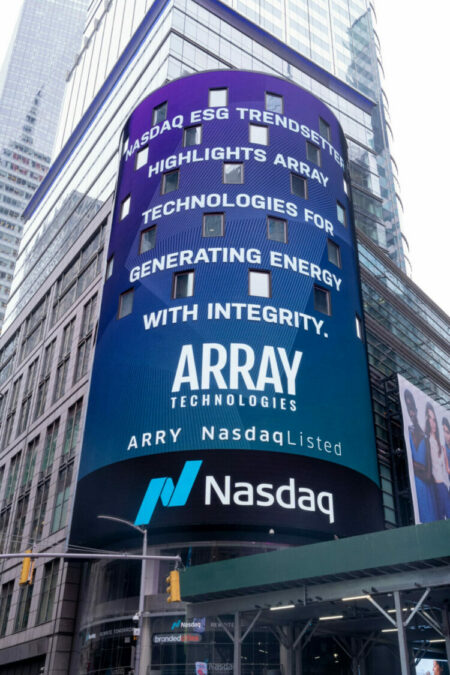
When Environmental, Social and Governance (ESG) emerged as an investing framework, it was misunderstood by some as simply a fleeting trend, but it is here to stay. For many publicly-traded companies, including ARRAY Technologies, it provides transparency for financial stakeholders – ranging from shareholders and customers to banks and insurance companies – to assess risks and potential rewards.
Our ESG reporting shows how we, as a renewable energy company, walk the talk on environmental responsibility when it comes to how we source materials and manufacture our products, which literally underpin utility-scale solar arrays. ESG reporting also holds us accountable to investing in our greatest asset: our employees.
We hope the current anti-ESG backlash fades as more people come to understand what our stakeholders – customers, investors and employees – already know: applying the fundamentals of investment analytics can provide a clearer assessment of value.
Whether or not ESG data is required by any regulatory framework, ARRAY will continue to provide ESG reports. They offer visibility into our business so that our stakeholders fully understand how we allocate capital to help solve the climate crisis with solar innovations. Likewise, ESG reporting commits us to diverse talent which allows us to optimally operate in each of our global markets with deep knowledge and various viewpoints.
To be sure, some ESG metrics may need refinement, as illustrated by debates surrounding Scope 3 emissions measurement accuracy, for example. ESG benchmarking and raters will continually improve.
Higher Calling or Standard Operating Procedure? ESG is Both
For ARRAY, ESG is naturally integrated with our core competencies and best practices. We know a company can perform well in business with ESG. We proudly live it every day.
As the focus on ESG intensifies, Nasdaq’s ESG Trendsetters series looks to highlight the top ESG professionals and teams around the world to discover how they are incorporating ESG factors into their corporate strategy, achieving meaningful impacts, and communicating with their stakeholders.
Our leadership recently met with Nasdaq to share our viewpoint for why ESG matters and how it’s integrated into our business and culture.
It’s no accident our ESG is led by our Chief Commercial Officer, Erica Brinker. Our ESG objectives are intractably linked with our commercial goals. Improving the sustainability of our products and supply chains helps our customers and revenues. Our entire business strategy is aimed at climate action and facilitating the global energy transition.
Governance is the driver to ensure the social and environmental goals can be accomplished. Our board’s Nominating, Governance and Social Committee includes four members of the board, including Chairman Brad Forth. The duties and responsibilities of all board members, including CEO Kevin Hostetler, upholds the promotion of long-term sustainable growth, which considers the social and environmental goals of the company.
Our ESG Journey
ARRAY’s 2021 ESG report included our first materiality assessment as we engaged stakeholders to help guide our ESG priorities. The report included 2025 goals with the following highlighted commitments for:
- Environment:
- Deliver components to support an additional 90,000 MW of solar power
- Reduce direct emissions intensity 30% from baseline year 2021
- Source 50% of direct energy consumption from renewable energy sources
- Social:
- Increase total workforce representation of women by 10% from baseline year 2021
- Increase non-executive management racial and ethnic minority representation by 10% from baseline year 2021
- Increase board representation of women 22% from baseline year 2021
- Governance
- Fulfilling the Nasdaq’s Board Diversity Rule
- Continuously evolving and adapting our Cybersecurity Framework’s security architecture, resiliency, response and recovery processes to meet persistent and growing threats.
- Updated Conflict Minerals policy to ensure our suppliers adhere to our high ethical standards and keep our supply chain
- Commitment to expanding GHGs inventory beyond Scope 1 and 2 emissions to incorporate Scope 2 supply-chain emissions
ARRAY aims to increasingly provide sustainability benefits for our products. For example, we have an agreement with Nucor to buy torque tubes and rolled steel produced with recycled steel. These materials are used by ARRAY to produce clamps, foundations and brackets, and other tracker components. Similarly, in 2021, our use of recycled aluminum at our Albuquerque increased by 11.8% to 3.5 million pounds.
Our 2022 ESG report to be published in Q2 will show further progress. ESG goals are not set arbitrarily. We reference the metrics of the Global Reporting Initiative and Sustainability Accounting Standards Board for stakeholders to clearly recognize our contributions within the broader ecosystem of ESG. These also serve as baseline metrics to identify growth opportunities and achieve results against objectives.
Customers rightfully want assurances our products are manufactured and distributed with the most environmentally preferable means possible. Investors want to see how we are increasing revenues while providing crucial components for renewable energy expansion. Demonstrating these commitments is also key in attracting and retaining talent. ESG benchmarks give everyone clarity on what we are doing and where we are going as a business.
As a renewable energy company, we believe we are held to a higher standard for ESG. What started as an investment management framework for risk assessments has evolved into an integral structure for business growth and integrity. ARRAY is proud to be a company rooted in and expanding with ESG.
The post ESG Metrics & Renewable Energy Companies: A Match Made in Sustainability appeared first on ARRAY Technologies.
]]>The post Why the First Dominican Republic Solar Tracking Site Chose ARRAY Trackers: Case Study appeared first on ARRAY Technologies.
]]>The Dominican Republic (DR) is in the process of overhauling its power grid. The goal is to generate 25% of the country’s power from renewable sources by 2025 and reach carbon neutrality by 2050. However, building out a reliable clean power grid in unpredictable weather proved to be challenging.
The need for extreme weather management called for a photovoltaic (PV) tracker with proven dependability in real-world settings. This case study looks at:
- the challenge of building out a reliable clean power grid in unpredictable weather,
- what made ARRAY’s DuraTrack the solution to the extreme weather challenge, and
- the results and increase in solar capacity.
In the same way technology constantly evolves at an exponential pace, ARRAY continues to innovate. The DuraTrack system has continued to evolve with numerous installation advantages introduced since the original Alamosa installation.
Download our Dominican Republic case study for all the details!
The post Why the First Dominican Republic Solar Tracking Site Chose ARRAY Trackers: Case Study appeared first on ARRAY Technologies.
]]>